


From the Editor
In enterprise technology, growth and innovation can create competitive advantage, but they can also increase complexity faster than an organization converts scale into economic value.
For 8x8, the challenge entering 2026 was whether leadership could translate platform breadth, AI investment, and enterprise reach into durable operating leverage while managing an increasingly demanding cost and competitive environment — regardless of whether the underlying platform remained relevant.
This issue examines that tension through a Results Leadership lens: with ambition not the constraint, disciplined sequencing becomes the differentiator. The real test for 8x8 is how precisely it prioritizes, executes, and converts scale into sustainable performance.
Introduction — Growth Is No Longer Enough

8x8 operates in one of the most competitive segments of enterprise software: cloud communications. Its unified platform integrates voice (UCaaS), contact center (CCaaS), and programmable APIs (CPaaS) into a single global architecture.
Enterprises increasingly want consolidated communications stacks that reduce vendor sprawl and improve data visibility. The strategic logic is clear.
However, in a capital-constrained environment, product breadth alone does not create shareholder value. This month’s analysis asks a harder question:
Can 8x8 convert platform ambition into durable operating leverage?
Scene One — The Platform Promise

8x8’s value proposition centers on integration.
Rather than stitching together multiple vendors for voice, messaging, contact center, and APIs, enterprises can operate on one global backbone. The company has layered in AI-driven enhancements — agent assist, workforce optimization, conversational intelligence — designed to deepen retention and increase cross-sell potential.
The thesis is straightforward:
Reduce vendor complexity
Increase account stickiness
Expand recurring revenue
Improve retention durability
Yet integration carries structural cost. Supporting telecom infrastructure, AI functionality, international compliance, and enterprise-grade uptime simultaneously requires sustained R&D investment and operational coordination.
The more capabilities unified under one platform, the greater the internal execution burden.
Scene Two — Operating Under Compression

Demand for unified communications remains intact. The issue is not market relevance — it is conversion efficiency.
According to 8x8’s FY2025 Form 10-K, the company continues to report operating losses while sustaining elevated sales, marketing, and R&D investments. Simultaneously, the competitive environment has intensified, increasing cost density across the industry:
AI feature escalation across competitors
Price competition from well-capitalized rivals
Rising infrastructure and cybersecurity costs
Greater enterprise scrutiny of IT budgets
These forces create structural compression.
The Leverage Conversion Gap
In Business Physics, sustainable value creation occurs when revenue growth outpaces cost growth, allowing operating leverage to expand margins over time.
8x8’s trajectory suggests revenue scale has improved, yet operating margin conversion has lagged. Sales and marketing intensity remains elevated, R&D investment supports AI competitiveness, and integration complexity absorbs scale benefits.
The issue is not demand. It is cost absorption.
Despite multi-year revenue expansion, operating margins remain negative — signaling that scale has not yet translated into durable leverage.
In capital-sensitive markets, investors reward margin inflection more than feature expansion.
This leverage imbalance becomes clearer when we examine where risk concentration is most acute.
Scene 2.75 — Risk Heat Map
Before designing transformation, disciplined leaders first assess where pressure is most concentrated.
A review of 8x8’s FY2025 Form 10-K risk disclosures reveals a consistent pattern: the company’s most material exposures cluster around cost structure durability, competitive AI escalation, retention sensitivity, and operational reliability.
When risk concentration centers in a single economic zone, the issue is rarely episodic. It is structural.
8x8 Risk Concentration Profile
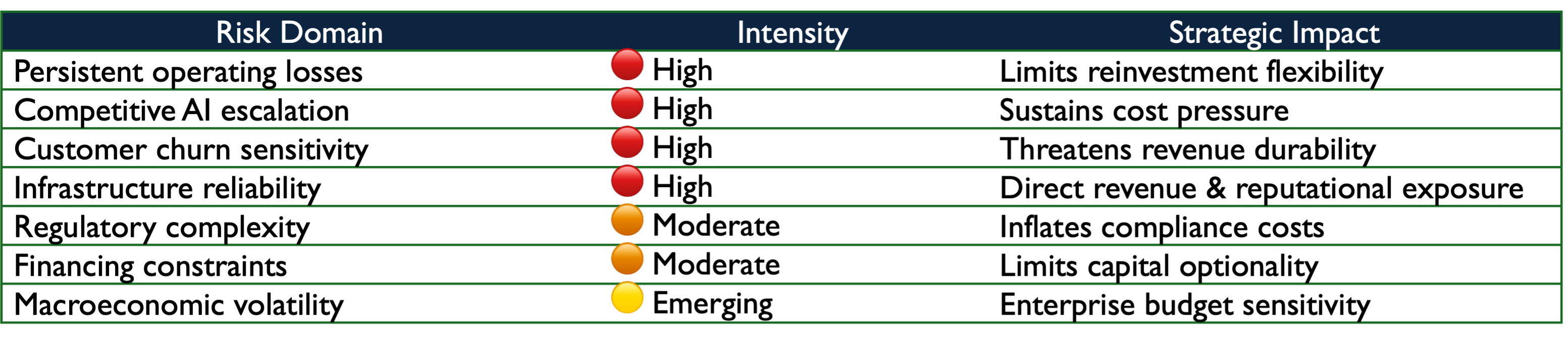
The clustering is telling.
Four of the highest-intensity risks sit directly inside the company’s economic engine: margin durability, customer retention, AI cost escalation, and infrastructure reliability.
This is not a peripheral risk profile. It is a core operating model stress test.
The implication is clear: 8x8’s challenge is not a single variable. It is execution density — managing AI investment, infrastructure scale, global compliance, and enterprise sales simultaneously while margins remain under pressure.
Transformation, therefore, must begin with economic stabilization.
Scene Three — Applying Hartley’s 7 Steps Strategic Problem-solving Framework

Hartley’s 7-Step Strategic Problem-Solving Framework moves from diagnosis to disciplined execution sequencing. When applied to 8x8, the underlying pattern becomes visible.
Define the real problem: Growth without margin conversion.
Quantify the impact: Sustained operating losses and valuation compression.
Identify root causes: Simultaneous expansion across AI investment, infrastructure complexity, and enterprise scale.
Generate options: Compete feature-for-feature, narrow scope, or differentiate on reliability and economics.
Evaluate trade-offs: Expansion without sequencing increases capital burn and execution risk.
Decide: Prioritize operating leverage before acceleration.
Execute: Tie AI investment and sales intensity to measurable retention and cost improvement.
The constraint is not ambition. It is simultaneity.
Multiple strategic vectors — AI escalation, global infrastructure, enterprise penetration — are being pursued while margin durability remains unresolved. When strategic initiatives outpace economic stabilization, leverage delays compound.
Diagnosis clarifies what must happen next: sequencing.
Scene Four — Sequencing the Transformation

Expansion without sequencing is one of the most common causes of strategic failure.
When firms pursue growth, AI acceleration, international expansion, and product enhancement simultaneously — without stabilizing their economic engine — complexity compounds faster than leverage improves. Costs rise. Margins compress. Management attention fragments.
For 8x8, the tension is not ambition. It is timing.
The company is operating in a capital-sensitive market while investing in AI capabilities, infrastructure reliability, international compliance, and enterprise sales expansion concurrently. Each initiative is rational in isolation. Together, they increase execution density.
Sequencing becomes non-negotiable.
Operating leverage must improve before acceleration begins.
A disciplined tiered framework clarifies the path forward:
Tiered Execution Model

The sequencing logic is unforgiving:
If Tier 1 is incomplete, Tier 2 amplifies inefficiency.
If Tier 2 lacks clarity, Tier 3 magnifies competitive noise.
If Tier 3 begins prematurely, capital strain returns.
This model does not restrain ambition. It preserves it.
In Business Physics terms, operating leverage must inflect before fixed investment accelerates. When expansion precedes stabilization, the cost curve steepens faster than the revenue curve.
The companies that endure AI-driven competitive cycles are not those that expand first — but those that expand after their economic engine is stabilized.
Scene Five — Blue Ocean Reframe

Sequencing stabilizes the engine. Differentiation determines where to drive it.
Even after leverage improves, competing inside a crowded UCaaS/CCaaS market on features alone invites escalating cost structures. In saturated technology markets, firms often respond to competitive pressure by accelerating roadmaps, layering incremental AI enhancements, and increasing promotional intensity.
Over time, this behavior raises industry-wide cost density without meaningfully redefining value.
A more disciplined alternative is to redefine the basis of competition itself.
Blue Ocean Strategy challenges leaders to identify where the industry is over-investing — and where customers may instead reward simplicity, predictability, and execution reliability.
For 8x8, the strategic inflection point is clear:
Is long-term advantage achieved by winning the AI feature race — or by making enterprise communications simpler, more reliable, and economically predictable?
ERRC Grid – Strategic Reframe

The opportunity is not to outspend competitors on AI features, but to create separation through disciplined clarity — fewer distractions, stronger economics, tighter positioning.
In capital-constrained markets, focus compounds. Proliferation dilutes.
Scene Six — Brightline Transformation Compass

Reframing competition defines where to compete. Governance determines whether execution holds.
Strategy clarity alone does not produce results. Transformation succeeds only when operating systems, incentives, and culture align with economic reality.
The Brightline Transformation Compass provides a governance architecture built on four reinforcing dimensions: Direction, Leadership, Operations, and Culture. For 8x8, alignment across these dimensions will determine whether sequencing and differentiation translate into durable leverage.
Direction — Strategic Coherence
8x8 must codify a clear hierarchy of priorities: margin durability before expansion, reliability before feature escalation, focus before proliferation. Strategic coherence reduces internal friction by clarifying not only what will be pursued — but what will not.
Leadership — Incentive Alignment
What leadership measures becomes what the organization optimizes. Incentives tied solely to bookings growth risk perpetuating cost escalation. Durable transformation requires executive metrics that emphasize operating leverage, retention strength, and capital efficiency alongside revenue.
Operations — Systems Precision
Cloud communications is unforgiving. Uptime reliability, cybersecurity resilience, and infrastructure scalability must operate with measurable rigor. AI investments should be gated by demonstrable impact on retention, productivity, or cost structure — not roadmap velocity alone.
Culture — Innovation Anchored to Accountability
AI markets reward innovation, but survival depends on discipline. Engineering velocity must coexist with financial stewardship. Accountability does not constrain creativity; it directs it toward measurable economic impact.
The Compass reinforces a central truth: strategy rarely fails because of poor ideas. It fails because execution systems are misaligned with economic constraints.
For 8x8, transformation success will depend less on vision and more on synchronized discipline — aligning priorities, incentives, operational rigor, and culture to convert scale into leverage.
Closing Insights — Precision Wins
8x8 stands at an execution inflection point. The company possesses meaningful strategic assets — a unified communications platform, expanding AI capabilities, established enterprise relationships, and global reach — yet the defining variable is no longer ambition, but leverage conversion. In cloud communications, integration scales, but so does operational complexity, cost density, and execution risk. As this analysis has shown, revenue growth alone will not determine outcomes; margin durability, sequencing discipline, competitive clarity, and governance alignment will. In capital-sensitive markets, innovation must translate into operating leverage or valuation compression persists. 8x8’s next chapter will therefore be defined not by how aggressively it expands, but by how precisely it stabilizes, differentiates, and converts scale into sustainable economic performance.
About Results Leadership
Averroes Results Leadership examines how leadership decisions, organizational capabilities, operating models, and technology combine to produce—or constrain—enterprise results.
Published by Averroes Business & Technology, LLC, the publication uses evidence-based analysis to connect strategy, execution, and measurable performance across Results Leadership in Business and Results Leadership in Government.
Business analyses incorporate the Business Physics Performance Assessment (BPPA™) to examine the underlying economics that reinforce—or constrain—sustainable performance.
Amir A. Moore, Founder & CEO of Averroes Business & Technology, serves as Publisher, with Lauren Floyd serving as Writer & Editor, helping shape each issue for clarity, rigor, and executive relevance.