


Introduction – Why This Special Edition Matters
This issue began with a real enterprise buying decision. After Averroes presented AOHAT to a prospective client, the leadership team decided not to proceed because it believed Microsoft Copilot could produce the same result. The question was reasonable—and more consequential than a simple product comparison.
By late 2025, Microsoft 365 Copilot had evolved well beyond drafting and summarization. Microsoft had introduced enterprise search, custom agents, and reasoning agents such as Researcher and Analyst for multi-step research and advanced data analysis. The question was therefore no longer whether Copilot could analyze organizational information. It could.
The more important question: When enterprise AI can search, synthesize, reason and analyze, what additional structure is required to turn organizational information into a reliable organizational-health diagnosis?
Scene One – The Misconception Was Really a Methodology Question

The rise of enterprise AI made an understandable assumption increasingly common: if an AI system can read documents, analyze data, identify patterns and generate a polished report, then a separate diagnostic application may appear redundant.
That assumption confuses analytical capability with diagnostic methodology. A capable AI assistant can interpret information supplied to it. A diagnostic system must additionally determine what should be assessed, how evidence should be structured, how conditions should be scored, how findings should be compared across dimensions, and how the results should be translated into priorities and action.
This distinction matters because organizational health is not a single prompt. Leadership, strategy, finance, operations, workforce, technology and culture interact as a system. A useful diagnosis requires a repeatable way to evaluate those conditions rather than relying only on the fluency of an AI-generated answer.
The issue is not whether Copilot can analyze. The issue is what governs the analysis.
Scene Two – What Microsoft 365 Copilot Could Actually Do in 2025

A fair comparison begins by describing Copilot accurately. By December 2025, Microsoft 365 Copilot was an enterprise AI platform capable of working across organizational information, not merely a writing assistant.
Microsoft’s 2025 releases included AI-powered enterprise search, an Agent Store and extensibility through Copilot Studio. Researcher and Analyst became generally available in June 2025. Researcher was designed for complex, multi-step research using work and external information; Analyst was designed for advanced data analysis and iterative reasoning.
Those capabilities meant Copilot could help leaders search organizational information, synthesize multiple sources, analyze data, surface insights and generate structured reports. A sufficiently engineered Microsoft solution could also incorporate custom agents, workflows and organizational knowledge.
Accordingly, the original proposition that Copilot simply ‘tells you what is in your documents’ is too narrow. Copilot could do substantially more.
Copilot can help leaders understand organizational information. That does not, by itself, make Copilot an organizational-health assessment methodology.
This distinction also changes the make-or-buy question. An organization could potentially engineer a Copilot-based diagnostic application. But doing so would require the organization to define and maintain the assessment model, scoring logic, evidence rules, workflows, governance, validation and longitudinal measurement that make the diagnostic repeatable.
Scene Three – AOHAT’s Distinctive Value Is the Diagnostic System

AOHAT’s differentiation is therefore not a claim that its underlying AI is inherently more intelligent than Copilot. Its differentiation is the structure surrounding the intelligence.
AOHAT applies a defined organizational-health assessment across 12 dimensions. The assessment process uses predetermined questions, structured response selections and supporting context. Those inputs are translated into scoring, cross-dimensional findings, priority areas, recommendations and an implementation path.
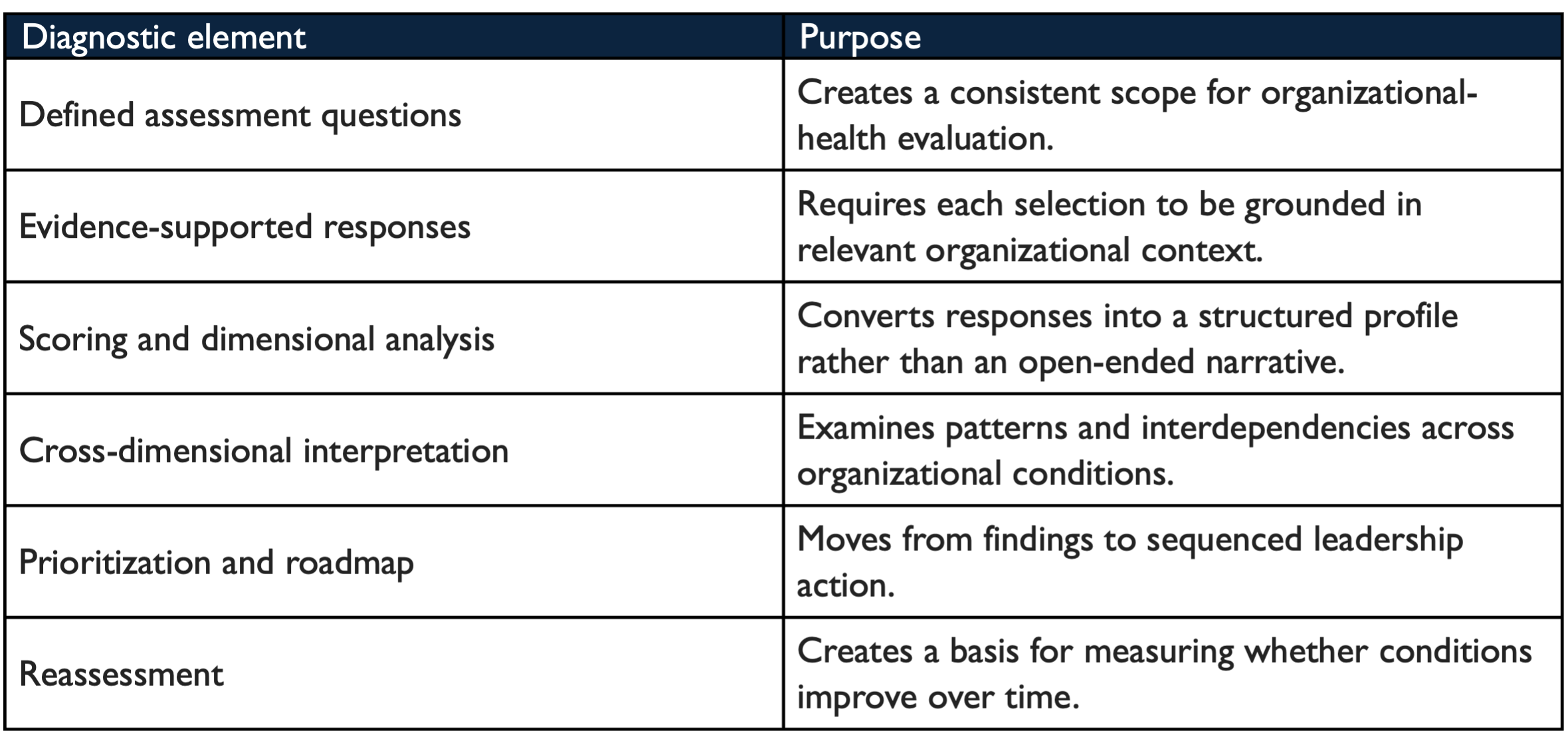
The result is a governed path from evidence to diagnosis. The AI assists the analysis, but the assessment architecture determines how the evidence is collected, interpreted and converted into a decision-oriented output.
Scene Four – A Real Enterprise Demonstration — Spirit Airlines

Averroes had already tested this distinction before the December Special Edition, although the example was not used in the original newsletter. On October 29, 2025, Spirit Airlines—identified in the demonstration as ULCC Airlines—was assessed through AOHAT using public company information.
The assessment inputs were grounded in Spirit’s public disclosures. For each AOHAT question, Averroes selected the applicable multiple-choice response and supplied contextual evidence supporting that selection. AOHAT then processed those structured inputs into an organizational-health assessment.
The resulting report produced an overall score of 70/100 and a multidimensional profile. Among the assessed areas, IT scored 88, Operations 84, Strategic Alignment 63, GenAI Tools and Adoption 47, and Finance 42. The report then moved beyond scoring to identify priority challenges, strategic recommendations and a sequenced transformation roadmap.
Spirit public evidence • Structured AOHAT questions • Evidence-supported selections • Scoring • Cross-dimensional findings • Priorities • Recommendations • Roadmap
The Spirit case should be treated as a demonstration, not as a validation study. One assessment does not establish that AOHAT is inherently more accurate than another analytical approach. It does demonstrate, however, that AOHAT imposes a repeatable diagnostic structure on enterprise evidence and converts that evidence into a defined sequence of assessment outputs.
The report itself also makes an important governance point: its findings are a point-in-time evaluation and should be considered alongside other business intelligence and professional judgment. That limitation is a strength when stated clearly. Diagnostic technology should inform leadership judgment, not replace it.
Closing Insights — The Difference Is What Governs the Intelligence

The prospective client’s question was not wrong. By late 2025, Microsoft 365 Copilot had become capable enough that leaders could reasonably ask why another AI-enabled application was necessary.
The answer is not that Copilot lacks analytical intelligence. Nor is it that AOHAT can uniquely read an organization. The more durable distinction is that AOHAT packages organizational diagnosis into a defined system: what to assess, how to capture evidence, how to score conditions, how to interpret dimensions together, how to prioritize findings and how to revisit the assessment over time.
Copilot can be part of a leadership team’s analytical environment. AOHAT is intended to provide the diagnostic architecture within which organizational-health evidence is evaluated.
Analytical capability answers questions. Diagnostic methodology governs how evidence becomes an assessment.
That distinction also clarifies the build-versus-buy decision. A company may choose to engineer its own organizational-health diagnostic using Microsoft Copilot, Copilot Studio or another enterprise AI platform. But the comparison is then no longer AOHAT versus an AI assistant. It is AOHAT versus the methodology, engineering, governance, validation and maintenance required to build and sustain an equivalent diagnostic system.
For leadership teams, that is the more consequential Results Leadership question: not which AI can generate the most convincing report, but which operating approach produces a consistent, evidence-grounded and actionable diagnosis.
Conclusion
Enterprise AI and organizational diagnosis are increasingly complementary rather than mutually exclusive. Microsoft 365 Copilot can accelerate research, analysis and knowledge work. AOHAT’s proposition is different: it provides a purpose-built organizational-health methodology that structures how evidence is evaluated and translated into leadership priorities.
The strongest use of AI in leadership is therefore not to substitute fluency for judgment. It is to combine capable technology, explicit methodology, traceable evidence and professional judgment so that leaders can move from information to understanding and from understanding to disciplined action.
About Results Leadership
Averroes Results Leadership examines how leadership decisions, organizational capabilities, operating models, and technology combine to produce—or constrain—enterprise results.
Published by Averroes Business & Technology, LLC, the publication uses evidence-based analysis to connect strategy, execution, and measurable performance across Results Leadership in Business and Results Leadership in Government.
Business analyses incorporate the Business Physics Performance Assessment (BPPA™) to examine the underlying economics that reinforce—or constrain—sustainable performance.
Amir A. Moore, Founder & CEO of Averroes Business & Technology, serves as Publisher, with Lauren Floyd serving as Writer & Editor, helping shape each issue for clarity, rigor, and executive relevance.