


From the Editor
Starbucks built its competitive advantage on more than coffee. Its strength came from the combination of customer connection, operational consistency, store culture, and an experience that differentiated the brand at global scale. Yet as Starbucks expanded its digital ecosystem, store formats, international footprint, and operating model, the complexity of delivering that experience increased as well.
In this issue, we examine Starbucks through a Results Leadership lens to understand why operational discipline has become central to the company’s strategy. The evidence suggests the real challenge is restoring alignment among store operations, customer experience, workforce engagement, financial discipline, and the operating principles that historically distinguished the brand — not simply generating growth.
Starbucks’ “Back to Starbucks” strategy and Green Apron Service Model signal an effort to address that challenge. The leadership question is whether the company can translate that strategic direction into consistent execution across a complex global enterprise—while preserving the scale, convenience, and innovation it has built over time.
— Lauren Floyd, Writer & Editor
Introduction – When Operational Complexity Begins to Dilute Competitive Advantage

For decades, Starbucks built one of the world’s most recognizable consumer brands through a combination of premium coffee, customer experience, operational consistency, and what it famously described as the “third place” between home and work.
Its global scale, digital ecosystem, loyalty platform, and international presence positioned the company as one of the dominant players in modern retail consumer experience.
However, scale alone does not guarantee sustained performance.
As organizations expand, operational complexity often increases faster than execution discipline, cultural alignment, and organizational agility.
Starbucks now appears to be confronting this reality directly.
Through its “Back to Starbucks” strategic theme, Green Apron Service Model, organizational simplification initiatives, and renewed emphasis on operational execution, leadership appears to recognize that the company may have gradually drifted away from several of the operational and cultural principles that originally differentiated the brand.
This raises a more fundamental strategic question:
Is Starbucks attempting to solve a growth problem—or an operational alignment problem?
This month’s analysis evaluates Starbucks through four integrated lenses:
the Averroes Business Physics framework,
Hartley’s 7-Step Strategic Problem-Solving model,
Blue Ocean Strategy,
and the Brightline Transformation Compass.
Collectively, these frameworks suggest Starbucks’ current challenges are not primarily rooted in demand weakness or brand deterioration.
Instead, the evidence increasingly points toward:
operational complexity, execution strain, margin pressure, and the difficulty of sustaining alignment within a globally scaled retail enterprise.
The analysis further suggests Starbucks’ current transformation initiatives may be directionally correct strategically.
The larger question is whether the company can successfully restore:
operational discipline,
customer intimacy,
cultural alignment,
and financial flexibility
while continuing to scale a highly complex global operating model.
Scene One – The Business Model and the Evolution of the Starbucks Experience

The global coffee retail industry remains one of the most operationally demanding segments within consumer discretionary retail. Success requires balancing:
premium brand positioning,
throughput efficiency,
labor management,
digital engagement,
supply chain execution,
and customer experience consistency.
Starbucks historically differentiated itself through:
premium product positioning,
strong store culture,
customer intimacy,
and its “third place” retail experience.
Over time, however, the company expanded into:
mobile ordering,
drive-thru formats,
digital loyalty ecosystems,
international expansion,
and increasingly complex operational structures.
These initiatives strengthened scale and convenience but also introduced additional operational complexity. The industry itself continues shifting toward:
speed, convenience, and digital engagement over traditional in-store experience.
Starbucks now appears to recognize that operational execution—not strategy formulation alone—may determine the next phase of performance.
This realization is reflected in:
the “Back to Starbucks” strategic messaging,
organizational simplification initiatives,
execution-focused leadership communication,
and the rollout of the Green Apron Service Model.
Collectively, these initiatives suggest management believes the company gradually drifted away from several of the operating principles and customer experience standards that originally fueled its success.
Scene Two – The Business Physics of a Global Coffee Retailer

Behind every strategy sits an economic engine that determines whether performance can be sustained over time.
Using the Averroes Business Physics framework, Starbucks was evaluated across six core dimensions:
revenue momentum,
cost structure,
capital intensity,
financial leverage,
cash conversion,
and return on invested capital.
Business Physics Score: 34.1
This score places Starbucks in the:
Constrained Performance Zone
indicating structural imbalance across several economic dimensions.
Key indicators include:
Revenue growth: 3.29%
EBIT margin: 9.55%
Debt / EBITDA: 8.52x
Free cash flow margin: 7.94%
ROIC: 10.20%
Capex intensity: 7.50%
The structure tells a very clear story:
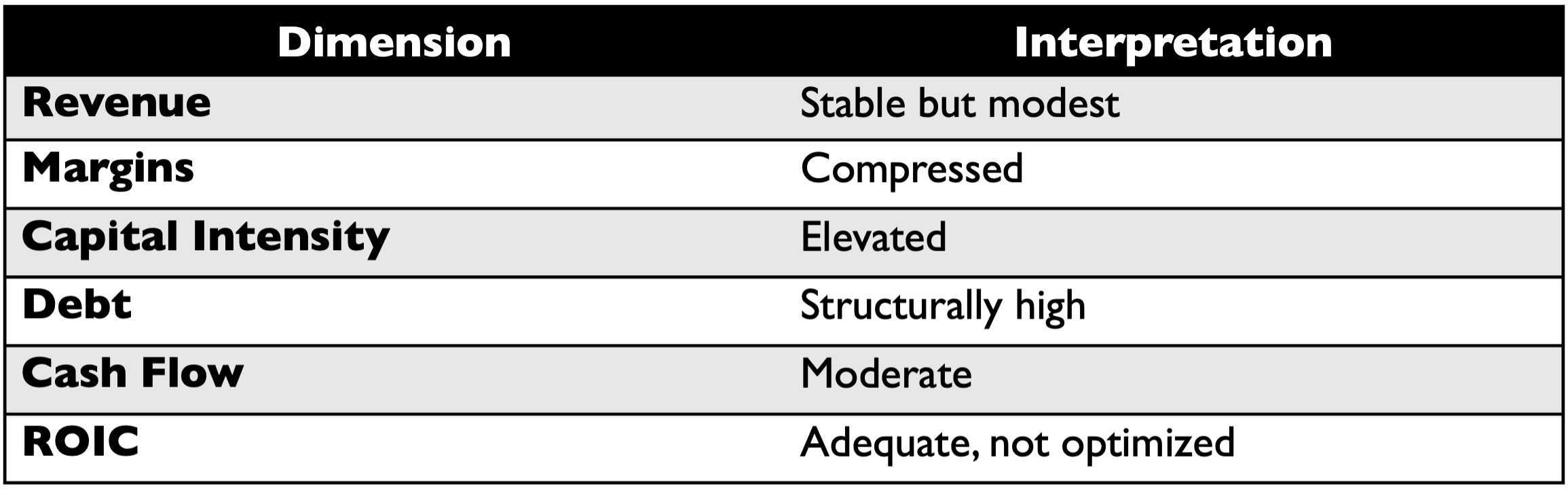
Unlike distressed companies experiencing outright collapse, Starbucks continues generating meaningful revenue and cash flow. However, the Business Physics model suggests the company’s operating structure is becoming increasingly difficult to optimize.
Most notably:
operating margins remain below elite retail standards,
capital requirements remain elevated,
and leverage significantly constrains financial flexibility.
This creates a structurally imbalanced profile where:
revenue stability is increasingly offset by declining financial quality and operational pressure.
Scene Three – Risk Concentration and Structural Pressure

Financial deterioration rarely occurs in isolation. Risk disclosures often reveal where structural pressure is concentrated.
For Starbucks, the most significant pressures appear concentrated in four areas:
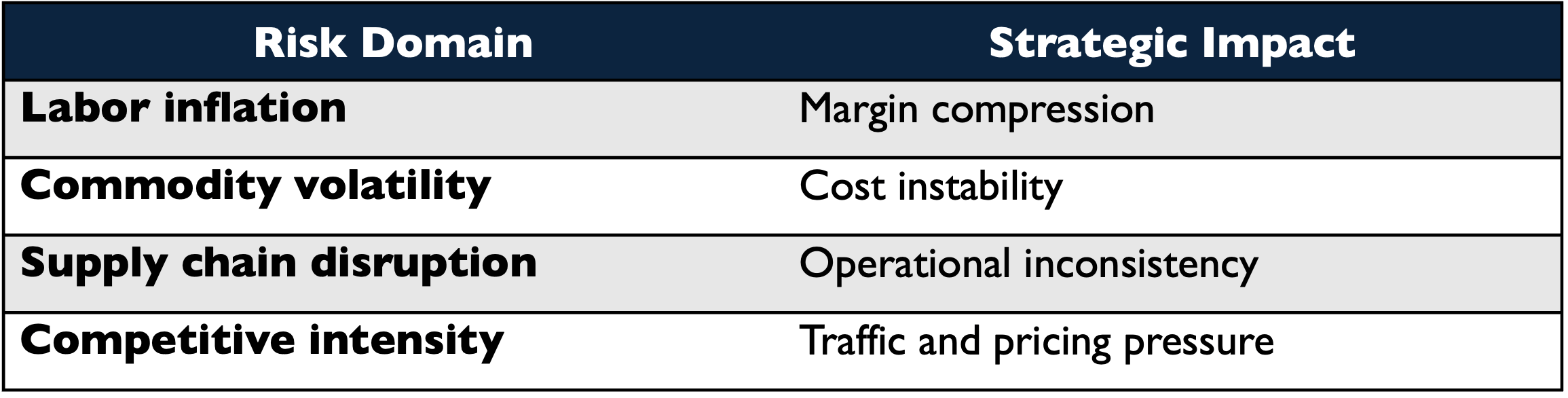
Additional pressure emerges from:
occupancy costs,
digital infrastructure investment,
international expansion complexity,
and operational execution requirements at scale.
The concentration pattern is important.
The company’s most significant pressures sit directly inside:
store operations,
labor management,
throughput execution,
and customer experience delivery.
These are not peripheral issues.
They are core to how Starbucks creates value.
Scene Four – Hartley’s 7-Step Strategic Problem-Solving Assessment
Strategic transformation efforts are most effective when leadership clearly understands the problem the organization is attempting to solve.
Using Hartley’s 7-Step Strategic Problem-Solving Framework, Starbucks’ recent initiatives—including its “Back to Starbucks” strategic positioning and Green Apron Service Model—appear to reflect an organizational effort to diagnose and correct operational and cultural drift that accumulated over time.
The central issue does not appear to be demand destruction or brand irrelevance.
Instead, the evidence suggests Starbucks may be confronting:
operational complexity, execution inconsistency, margin pressure, and weakening alignment between scale and customer experience.
Applying the Hartley framework reveals the following pattern:
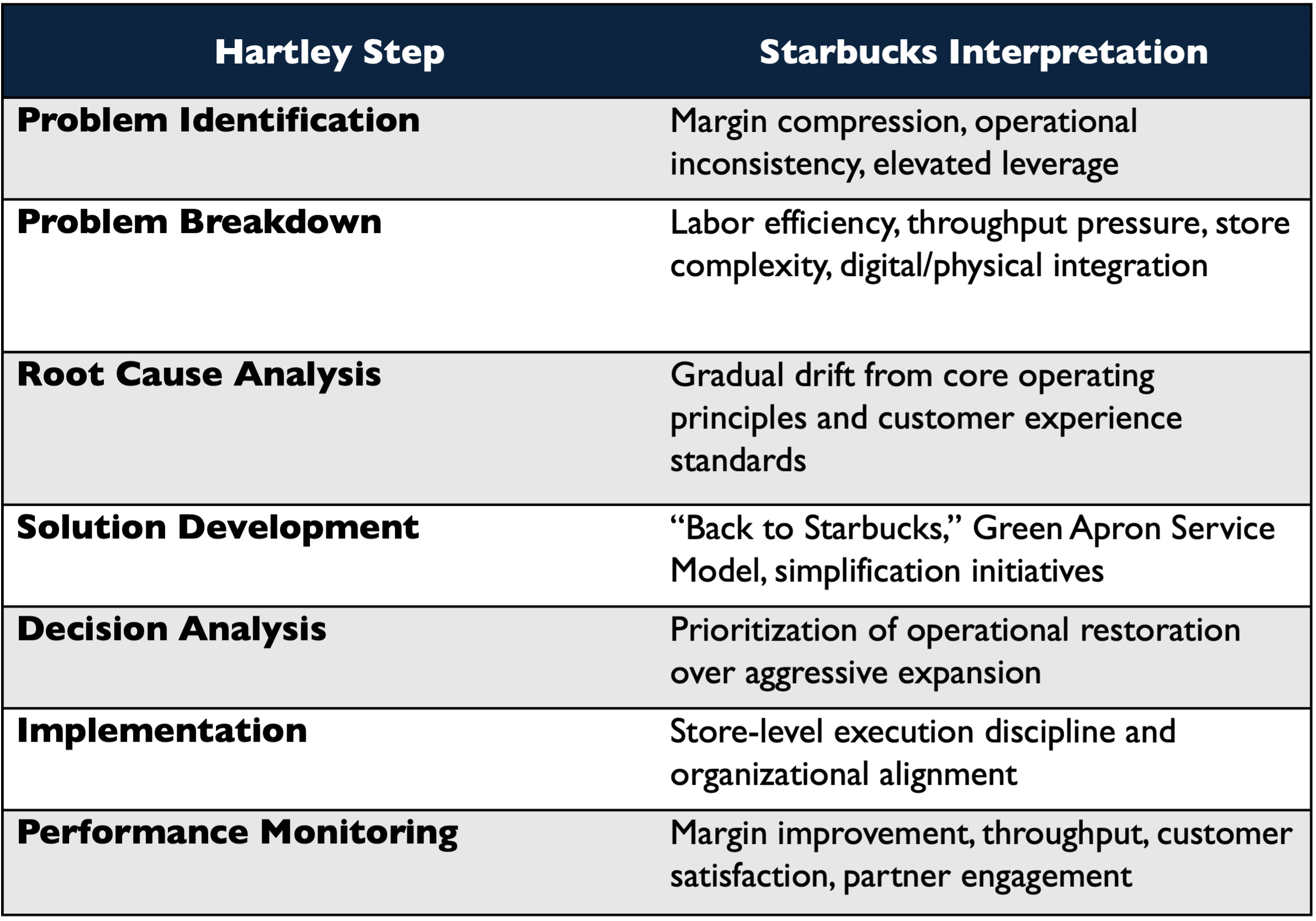
The framework suggests Starbucks’ leadership increasingly recognizes that:
scale alone does not guarantee sustainable performance.
As organizations expand, complexity can dilute operational discipline, weaken customer intimacy, and reduce organizational agility.
The “Back to Starbucks” initiative therefore appears to represent more than a branding exercise. It appears to be an attempt to reconnect the company with the operating principles that historically differentiated the brand.
This interpretation aligns closely with the Business Physics analysis, which identified:
compressed margins,
elevated capital intensity,
and significant financial gravity,
despite stable revenue and moderate cash generation.
The key strategic question is no longer:
“Can Starbucks grow?”
The more important question may be:
“Can Starbucks restore operational alignment at global scale while maintaining growth, innovation, and financial discipline simultaneously?”
Scene Five – Blue Ocean Strategy Assessment

Blue Ocean Strategy argues that sustainable success is rarely achieved through competing harder within existing market conditions. Instead, organizations create long-term differentiation by redefining value creation itself.
The coffee retail industry has increasingly become:
convenience-driven,
digitally competitive,
operationally complex,
and highly saturated.
In this environment, Starbucks appears to be attempting to reposition differentiation away from pure convenience and back toward:
customer connection,
service quality,
brand authenticity,
and operational consistency.
Viewed through a Blue Ocean lens, the “Back to Starbucks” initiative appears to be an attempt to restore differentiated value rather than simply increase transactional throughput.
The Green Apron Service Model further reinforces this interpretation by emphasizing:
partner engagement,
customer interaction,
standardized execution,
and store-level service consistency.
Using the Eliminate-Reduce-Raise-Create (ERRC) framework, Starbucks’ strategic direction can be interpreted as follows:
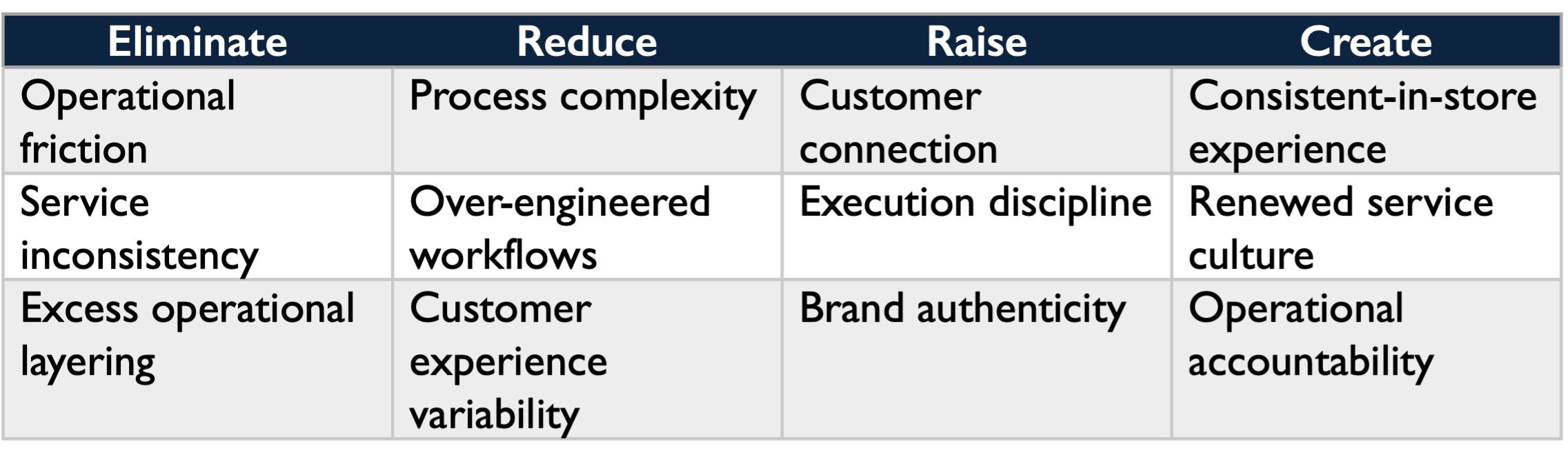
From this perspective, Starbucks does not appear to be abandoning digital transformation or growth initiatives.
Instead, leadership appears to be recognizing that:
operational excellence and customer experience remain core components of the company’s differentiated value proposition.
The strategic logic appears directionally sound.
However, Blue Ocean Strategy also highlights an important risk:
differentiation can erode when operational complexity outpaces organizational alignment.
This may be precisely the pressure Starbucks is now attempting to correct.
Scene Six – Brightline Transformation Compass Assessment

Research consistently shows that most transformation initiatives fail not because strategy is incorrect, but because execution breaks down during implementation.
The Brightline Transformation Compass provides a useful framework for evaluating whether Starbucks’ current transformation initiatives are positioned for successful execution.
The assessment reveals a mixed but promising picture.
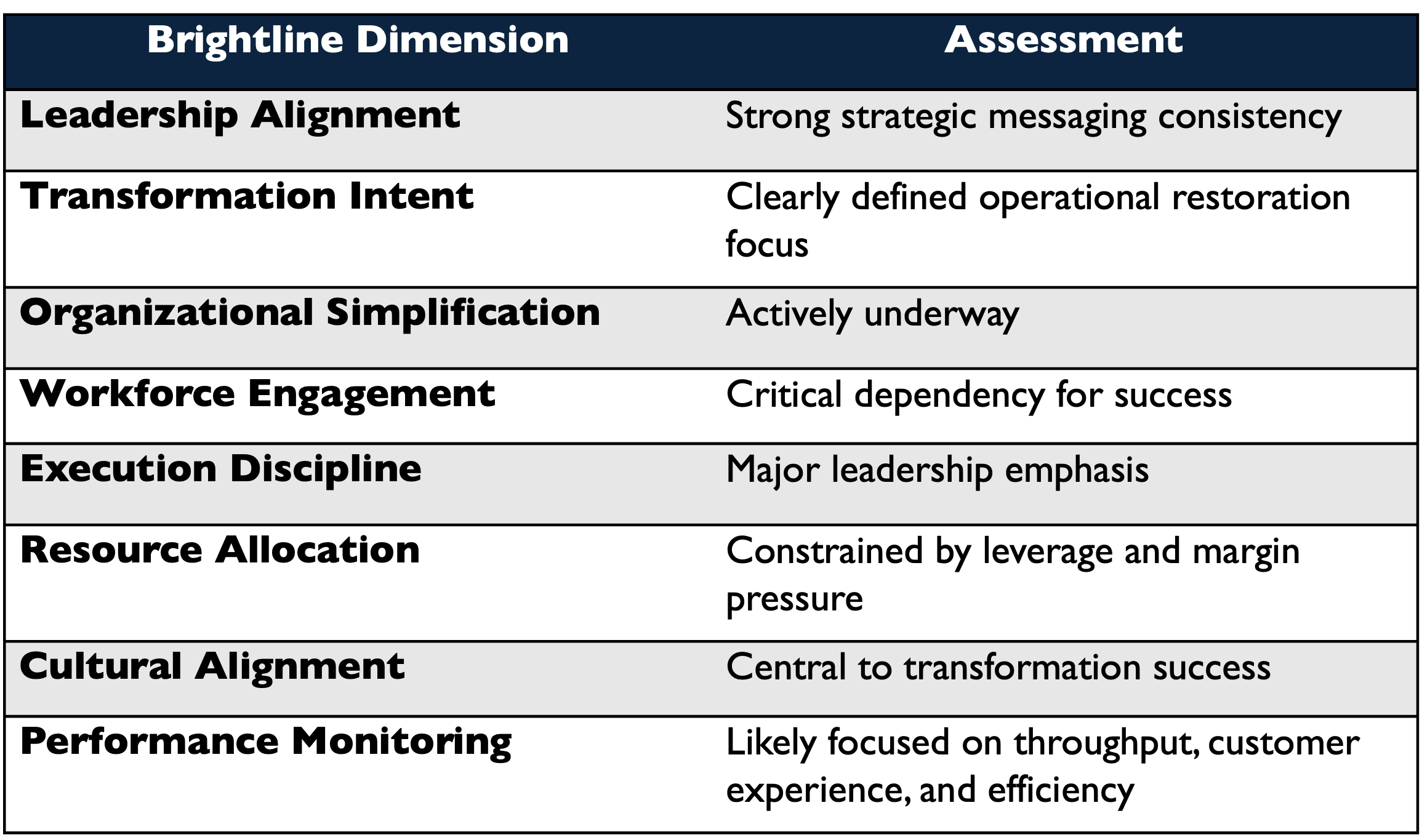
One of the strongest indicators supporting Starbucks’ transformation effort is the consistency of leadership messaging around:
simplification,
accountability,
execution,
operational discipline,
and customer experience restoration.
This suggests leadership appears aligned around the nature of the problem.
However, Brightline also highlights several execution risks.
Most notably:
labor-intensive operating models,
global scale,
digital/physical integration complexity,
and elevated financial leverage
increase the difficulty of sustaining transformation momentum over time.
In many organizations, transformation initiatives struggle when:
cultural alignment weakens,
operational incentives conflict,
or financial pressure forces short-term tradeoffs.
For Starbucks, the ultimate success of the “Back to Starbucks” initiative may therefore depend less on strategic vision and more on:
disciplined execution at the store and operational level across the enterprise.
The transformation appears directionally correct.
The larger challenge will likely be sustaining consistency and alignment throughout a globally scaled retail system operating under increasing economic pressure.
Final Insights – When Operational Alignment Becomes the Competitive Advantage

Starbucks remains one of the world’s most recognized consumer brands with meaningful advantages in:
scale,
brand equity,
digital ecosystem strength,
customer loyalty,
and global reach.
However, the company’s current condition illustrates a broader leadership lesson applicable far beyond coffee retail.
As organizations scale, complexity often expands faster than operational alignment.
Over time, companies can gradually drift away from the operating principles, cultural standards, and execution disciplines that originally created their competitive advantage.
The evidence suggests Starbucks may now recognize this dynamic.
The company’s recent initiatives—including:
“Back to Starbucks,”
the Green Apron Service Model,
organizational simplification,
and execution-focused leadership messaging—
collectively indicate an effort to restore operational coherence across the enterprise.
The Business Physics analysis demonstrated that Starbucks’ challenges are not primarily rooted in demand weakness.
Instead, the pressure appears concentrated in:
operational execution,
margin structure,
capital intensity,
and financial flexibility.
The Hartley framework further suggests leadership increasingly understands the underlying problem.
Blue Ocean analysis indicates the strategic direction appears aligned with restoring differentiated customer value.
The Brightline Transformation Compass suggests the long-term outcome will depend on whether the company can successfully sustain execution discipline, workforce alignment, and operational consistency at scale.
Ultimately, Starbucks does not appear to have a strategy formulation problem.
It appears to have an:
execution alignment and operating model optimization challenge.
And in mature, globally scaled organizations, that distinction often determines whether transformation succeeds or fails.
About Results Leadership
Averroes Results Leadership examines how leadership decisions, organizational capabilities, operating models, and technology combine to produce—or constrain—enterprise results.
Published by Averroes Business & Technology, LLC, the publication uses evidence-based analysis to connect strategy, execution, and measurable performance across Results Leadership in Business and Results Leadership in Government.
Business analyses incorporate the Business Physics Performance Assessment (BPPA™) to examine the underlying economics that reinforce—or constrain—sustainable performance.
Amir A. Moore, Founder & CEO of Averroes Business & Technology, serves as Publisher, with Lauren Floyd serving as Writer & Editor, helping shape each issue for clarity, rigor, and executive relevance.