


From the Editor
Growth is often measured by how quickly an organization expands. The more consequential question is whether each stage of expansion makes the enterprise more productive.
Dutch Bros entered late 2025 demonstrating that rapid shop growth could coexist with stronger revenue, improving transactions, digital engagement, and operating leverage. Yet its increasingly company-operated model also placed greater responsibility on leadership to coordinate capital, people, technology, supply chain, and culture as the network scaled.
This issue examines convenience not simply as digital access, but as the product of an integrated growth system—one capable of making each successive stage of expansion more productive without diluting the customer experience and culture that distinguish the brand.
— Lauren Floyd, Writer & Editor
Introduction – Convenience as a Growth System
Dutch Bros entered late 2025 with a problem many growth companies would welcome: the evidence showed that rapid expansion and improving economics could coexist. The company ended 2024 with 982 shops, revenue of approximately $1.28 billion, stronger mature-shop productivity, improving shop-level margins, and materially higher operating cash flow.
The strategic question was therefore larger than whether convenience had shifted from physical to digital channels. Dutch Bros was already combining drive-thru access, Dutch Rewards, mobile ordering, product innovation, and a distinctive service culture. The emerging leadership test was whether those capabilities could continue reinforcing one another as an increasingly company-operated network became larger and more complex.
Executive question: Can Dutch Bros make each successive stage of expansion more productive without diluting the culture and operating discipline that make the model work?
Scene One — A Brand Forged Through Connection

Dutch Bros has always differentiated itself through experience as much as product. Its broista-led service model, highly customizable beverage menu, drive-thru format, and community orientation create a customer experience that is difficult to separate from the brand itself.
That culture also performs an operating role. Dutch Bros develops regional operators internally, uses structured broista training, and builds leadership pathways intended to reproduce service behaviors as the network expands. As of year-end 2024, the company and its franchise partners employed approximately 26,000 people, with roughly 18,000 in company-operated shops and headquarters.
This matters because Dutch Bros was increasingly responsible for delivering the experience itself. At year-end 2024, 670 of its 982 shops were company-operated and 312 were franchised. Of the 151 shops opened during 2024, 128 were company-operated. Growth therefore brought more than new locations; it brought greater direct responsibility for real estate, capital, staffing, training, supply chain, technology, controls, and cultural replication.
Culture, in this model, is not simply a brand promise. It is part of the operating system through which shop productivity and customer loyalty are reproduced.
Scene Two — Growth Was Becoming More Productive
The original issue framed the competitive battleground as a shift from geographic proximity to digital proximity. Digital access clearly mattered, but the operating evidence points to a more integrated story: physical expansion and digital convenience were already working together.
In FY2024, revenue increased 32.6% while total shop count increased 18.2%. Systemwide average unit volume rose to approximately $2.02 million and systemwide same-shop sales increased 5.3%. Company-operated gross margin improved to 22.3%, company-operated contribution margin reached 29.7%, and SG&A declined to 18.3% of revenue. Operating cash flow increased to approximately $246 million.
Digital adoption was becoming another productivity layer. Mobile ordering had been implemented in more than 95% of systemwide shops, while Dutch Rewards represented 67.8% of FY2024 transactions. Management positioned mobile order alongside innovation, paid media, loyalty sophistication, and food as sales layers intended to increase frequency and address customer needs across dayparts.
The relationship was increasingly one in which the physical network and digital access created greater convenience, increased frequency and throughput, and ultimately improved shop productivity.
Digital convenience was therefore not an alternative to physical growth. Its strategic value depended on making the physical network more productive.
The Financial Pulse: Business Physics Performance Assessment (BPPA™)
For this retrospective archive assessment, Averroes applied its Business Physics Performance Assessment (BPPA™) to Dutch Bros’ FY2024 financial and operating model. BPPA™ evaluates six dimensions—Revenue Momentum, Cost Structure, Capital Intensity, Financial Gravity, Cash Conversion, and Energy Efficiency—using company-reported financial data, calculated performance metrics, and defined benchmark ranges.
Each dimension is assessed independently and then considered as part of an integrated enterprise system. The purpose is not simply to measure financial performance, but to identify where the underlying economics reinforce—or constrain—the organization’s ability to produce sustainable results. Because Dutch Bros was deliberately expanding a predominantly company-operated network, capital intensity is interpreted as an investment-productivity question rather than an assumption that lower capital spending is inherently better.
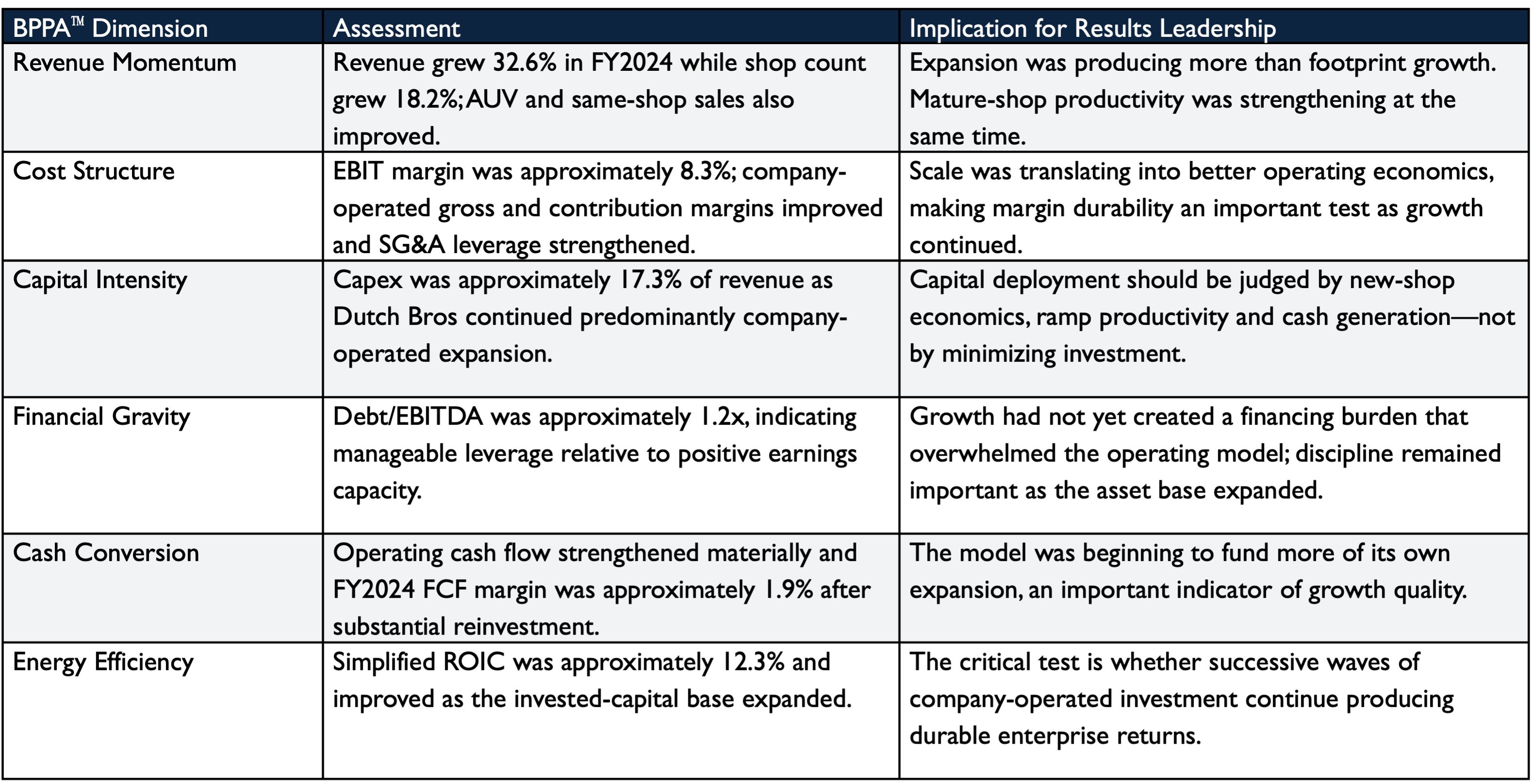
Viewed together, the BPPA™ dimensions show a growth system becoming more productive as it scaled. Revenue momentum was exceptional; operating profitability and shop-level economics improved; corporate cost leverage strengthened; cash generation expanded; and return efficiency improved while Dutch Bros continued to invest in a predominantly company-operated network.
Scene Three — Redefining Convenience Through Productivity
The original issue was correct that convenience was changing. But the evidence supports a different definition of the strategic opportunity. Convenience was no longer simply physical proximity, and it was not simply digital proximity either. It was the coordinated product of physical access, digital access, throughput, personalization, loyalty, service, and operating capacity.
By 2025, that system was generating stronger transaction evidence. In Q2, systemwide same-shop sales increased 6.1%, including 3.7% transaction growth. By Q3, systemwide same-shop sales increased 5.7%, including 4.7% transaction growth; company-operated same-shop sales increased 7.4%, including 6.8% transaction growth. Dutch Bros reported its fifth consecutive quarter of positive transaction growth.
That shift is important. FY2024 same-shop growth had been largely ticket-led, with systemwide transactions essentially flat. The 2025 evidence showed customers visiting more frequently while the company continued opening shops.
At the same time, Q3 introduced a useful constraint. Company-operated gross margin declined to 21.0% from 22.2% a year earlier, and contribution margin declined to 27.8% from 29.5%. Growth remained strong, but growth did not eliminate the need to manage commodity costs, labor, pre-opening expense, and operating execution.
The Results Leadership question was therefore not whether Dutch Bros could grow. It was whether each successive stage of growth could remain economically productive.
The Growth System That Must Stay Aligned
Dutch Bros’ next phase depended on several enterprise systems moving together. Optimizing any one in isolation could weaken another.
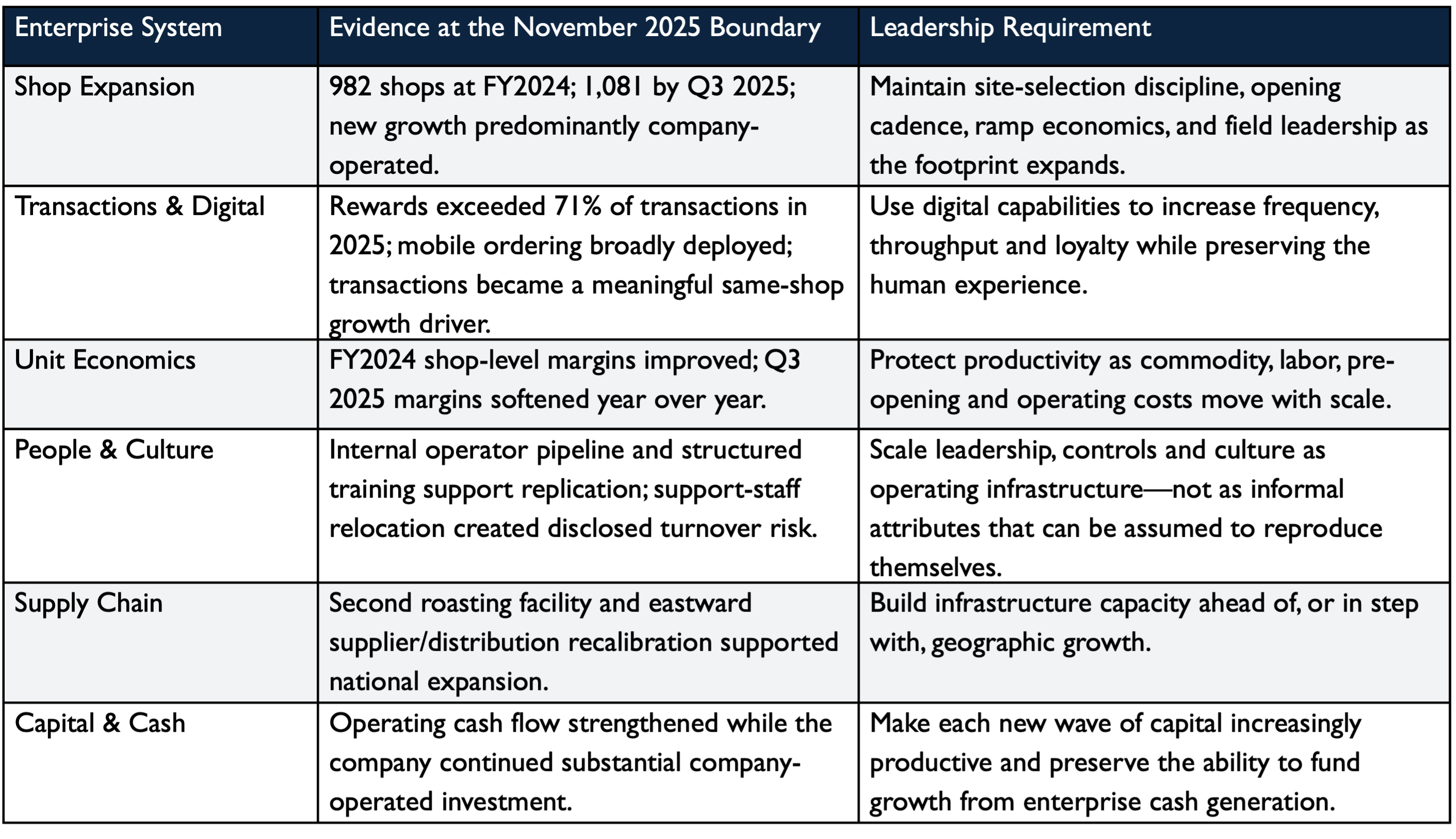
The sequence matters. More shops without leadership capacity can strain execution. More digital demand without throughput can reduce convenience. More transactions without margin discipline can weaken economics. More culture without scalable systems can become inconsistent as the organization grows. Results Leadership requires the relationships among these capabilities to remain aligned.
Scene Four — A Disciplined Path Forward

Dutch Bros did not need a reinvention. It needed to preserve the economic and cultural coherence of a model that was already producing strong growth. The evidence suggests four leadership priorities.
Make shop productivity the governing growth test. New-shop count should remain connected to AUV development, same-shop sales, transaction growth, contribution margins, cash generation, and return on invested capital. Expansion is strongest when the existing network becomes more productive at the same time.
Treat digital as a productivity capability. Mobile ordering, Dutch Rewards, segmentation, and personalization should increase frequency, throughput, predictability, and loyalty through the shop network. Digital success is therefore measured by the economics and customer experience it improves—not by digital activity alone.
Scale culture through operating systems. Internal operator development, broista training, leadership pathways, support functions, and controls are the mechanisms that allow the Dutch Bros experience to survive geographic scale. Culture becomes more durable when it is supported by repeatable capabilities.
Keep infrastructure synchronized with expansion. Roasting capacity, distribution, sourcing, technology, real estate, field leadership, and corporate support must expand at a pace that enables shop growth rather than reacting after complexity appears.
The objective is not to replace physical convenience with digital convenience. It is to create a system in which every access point—shop, drive-thru, app, loyalty interaction, and broista encounter—makes the overall network more productive.
Closing Insights — Growth Quality Becomes the Leadership Test
Dutch Bros is not a turnaround case. Nor, by the November 2025 evidence boundary, was it a company searching for proof that its concept could scale. Revenue, shop count, AUVs, same-shop sales, transactions, shop-level economics, operating cash flow, and digital participation provided evidence that the model was already scaling with increasing productivity.
That success changes the leadership challenge. As Dutch Bros becomes larger and more company-operated, the enterprise itself must absorb more complexity. Capital deployment, people development, supply chain, technology, customer experience, and cultural replication become increasingly interdependent.
The central Results Leadership lesson is therefore not that Dutch Bros should choose access over expansion. It is that access and expansion must reinforce one another. Physical growth creates the network. Digital capabilities increase the network’s reach and productivity. Culture differentiates the experience. Operating discipline converts all three into economics.
About Results Leadership
Averroes Results Leadership examines how leadership decisions, organizational capabilities, operating models, and technology combine to produce—or constrain—enterprise results.
Published by Averroes Business & Technology, LLC, the publication uses evidence-based analysis to connect strategy, execution, and measurable performance across Results Leadership in Business and Results Leadership in Government.
Business analyses incorporate the Business Physics Performance Assessment (BPPA™) to examine the underlying economics that reinforce—or constrain—sustainable performance.
Amir A. Moore, Founder & CEO of Averroes Business & Technology, serves as Publisher, with Lauren Floyd serving as Writer & Editor, helping shape each issue for clarity, rigor, and executive relevance.