


From the Editor
Growth is one of the clearest signals that a market values what a company has built. But growth alone does not establish that the underlying enterprise is becoming stronger.
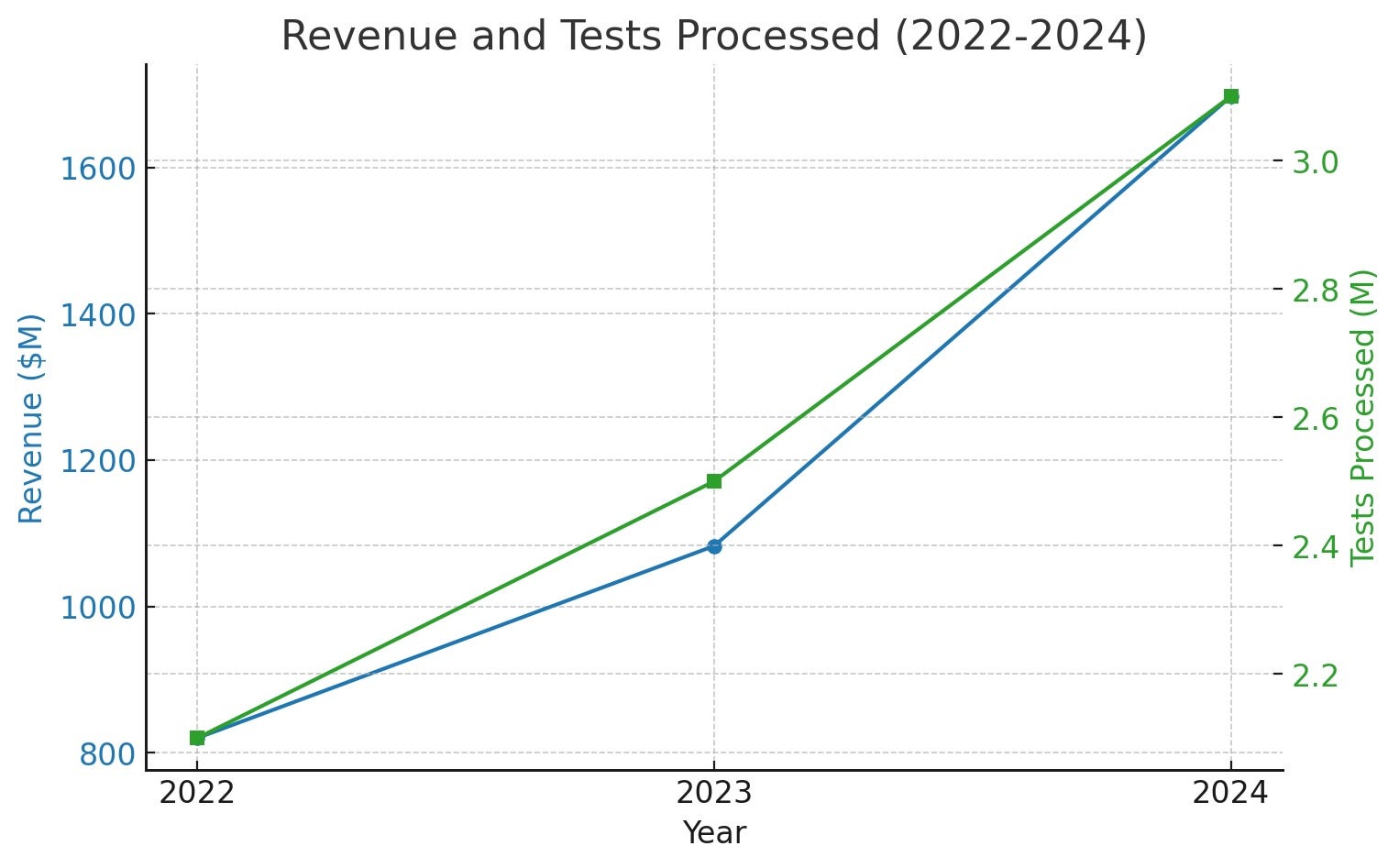
That distinction is particularly important for Natera, Inc., a precision-medicine company whose cell-free DNA technologies span women’s health, oncology, and organ health. From 2022 through 2024, Natera’s revenue more than doubled—from approximately $820 million to nearly $1.7 billion—while annual test volume increased from roughly 2.1 million to 3.1 million. Over the same period, its net loss narrowed substantially.
By mid-2025, the story had advanced further. Revenue continued to grow faster than overall test volume, gross margins exceeded 63%, company-reported cash flow was positive, and oncology testing was expanding at a markedly faster rate than Natera’s overall testing business.
These results change the leadership question.
Natera’s challenge was no longer simply whether it could generate growth or improve reimbursement. It was whether increasingly favorable economics at the product and gross-margin levels could propagate through the broader enterprise—while the company continued investing in the science, technology, clinical evidence, commercial capabilities, and people responsible for that growth.
This issue examines that transition: from generating growth to making growth increasingly productive.
Scene One — Growth Changes the Equation

Natera operates at the intersection of molecular diagnostics and precision medicine.
Its portfolio spans three principal areas: women’s health, including Panorama and Horizon; oncology, led by Signatera; and organ health, including Prospera. The original issue correctly recognized that this portfolio placed Natera in expanding markets while simultaneously increasing the demands on its operating model.
The scale of the growth is striking.
Revenue increased from approximately $820.2 million in 2022 to $1.083 billion in 2023 and $1.697 billion in 2024. During the same period, processed tests increased from approximately 2.07 million to 2.50 million to 3.06 million. Net losses moved in the opposite direction—from approximately $547.8 million in 2022 to $434.8 million in 2023 and $190.4 million in 2024.
That combination matters.
Natera was not simply selling more tests. Revenue was growing substantially faster than test volume, while losses were narrowing. Product revenue accounted for approximately 99% of 2024 revenue, and Natera identified continued commercial growth in Signatera, Panorama, and Horizon as major contributors to volume expansion.
By Q2 2025, the relationship became even more revealing.
Quarterly revenue increased 32.2% year over year to $546.6 million, while processed-test volume increased 12.2%. Natera attributed product-revenue growth not only to increased volume but also to average-selling-price improvements and incremental cash collections associated with tests delivered in prior periods.
Growth was therefore becoming more economically productive.
But the portfolio was not growing uniformly.
Natera performed approximately 188,800 oncology tests in Q2 2025, an increase of 50.6% from the prior-year quarter. Overall test volume increased only 12.2%. Signatera also achieved record sequential clinical-unit growth during the quarter.
That divergence is strategically important.
Women’s health remained a foundational business, but oncology was becoming an increasingly powerful source of incremental growth. As that occurs, leadership must manage more than volume. Product mix, reimbursement, clinical evidence, commercial adoption, cost-to-serve, and organizational investment begin interacting to determine whether growth strengthens the economics of the enterprise.
Results Leadership Insight
When growth begins improving the economics of a business, leadership must determine whether those gains can scale faster than the organization required to support them.
That takes us beyond the question of how quickly Natera can grow.
The next question is what that growth is producing.
Scene Two — When Growth Becomes More Productive
The original issue approached Natera’s future primarily as a hypothetical: higher reimbursement, lower operating costs per test, greater international penetration, and more efficient R&D could create a more profitable company.
By mid-2025, however, several of those economic relationships were already becoming observable.
Business Physics Performance Assessment (BPPA™)
Averroes’ Business Physics Performance Assessment (BPPA™) examines how an organization’s financial and operating model translates strategy into enterprise performance. The assessment evaluates six dimensions—Revenue Momentum, Cost Structure, Capital Intensity, Financial Gravity, Cash Conversion, and Energy Efficiency—using company-reported financial data, calculated performance metrics, and defined benchmark ranges.
Each dimension is assessed independently and then considered as part of an integrated enterprise system. The purpose is not simply to measure financial performance, but to identify where the underlying economics reinforce—or constrain—the organization’s ability to produce sustainable results. For this retrospective assessment, the BPPA™ uses Natera’s FY2022–FY2024 reported results; first-half 2025 evidence is used separately to test whether the FY2024 direction was continuing.
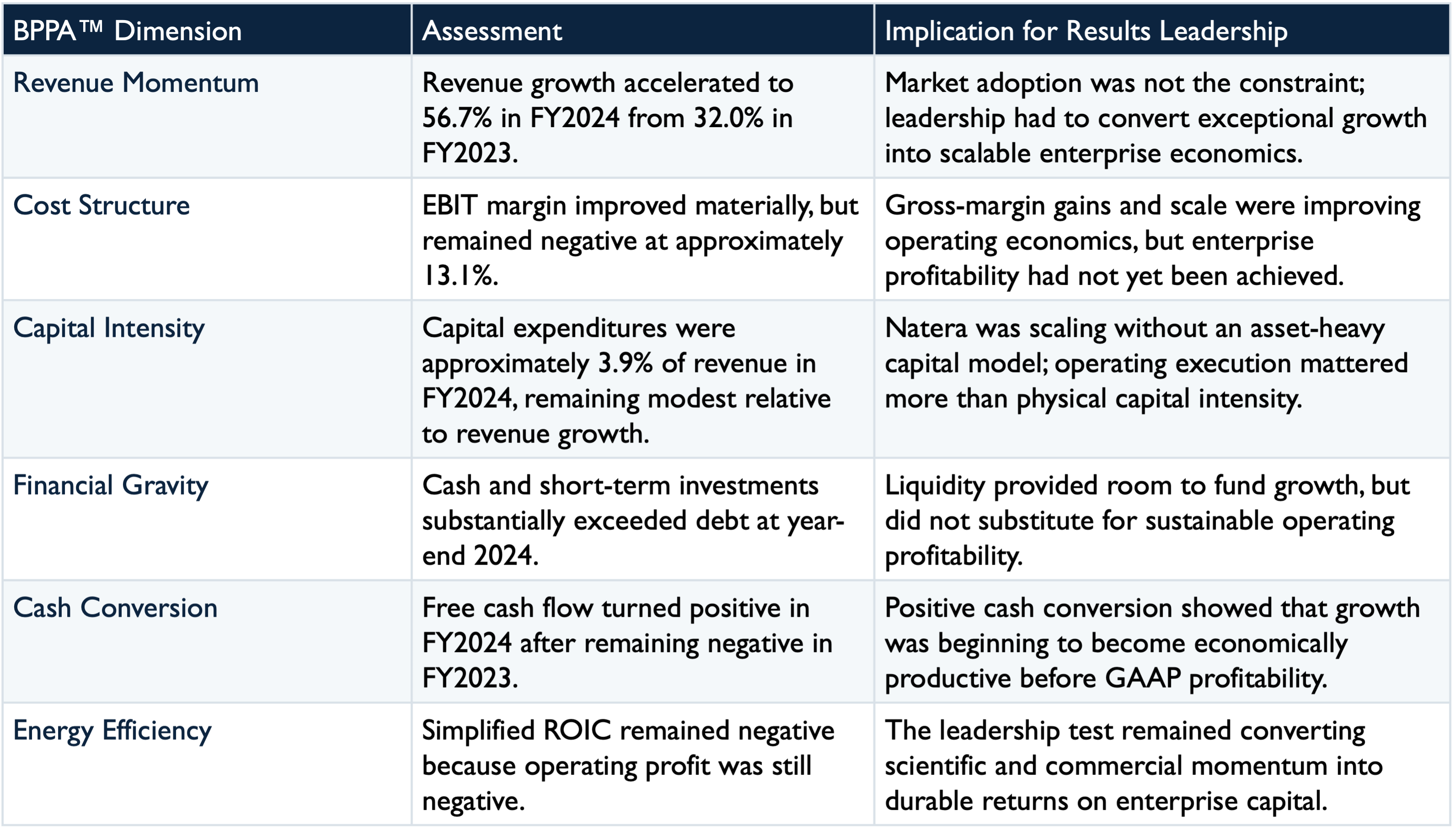
Viewed together, the BPPA™ dimensions show that Natera had reached a genuine economic inflection point by FY2024. Exceptional revenue momentum, improving cost economics, modest capital intensity, strong liquidity, and positive free cash flow demonstrated that growth was becoming more productive. Yet negative EBIT and simplified ROIC showed that the transition was incomplete. The Results Leadership challenge was therefore not simply to preserve growth, but to make each successive stage of growth contribute more consistently to enterprise profitability and returns.
Revenue Quality: Beyond the Reimbursement Question
The original issue placed reimbursement at the center of Natera’s profitability challenge. That insight remains important. Natera itself identifies adoption and reimbursement as critical to its business and notes that it continues investing resources to increase both.
But reimbursement should be viewed as part of a larger system.
The economics of the business depend on the interaction among test volume, product mix, reimbursement and average selling price (ASP), collections, cost per test, gross margin, and ultimately cash generation.
No single variable explains the entire system.
The Q2 evidence demonstrates why. Revenue grew substantially faster than test volume because volume growth was accompanied by average-selling-price improvement and additional collections. At the same time, lower cost of revenues associated with tests processed contributed to gross-margin expansion.
The leadership challenge is therefore broader than negotiating higher reimbursement rates.
It is improving the quality and productivity of revenue.
Results Leadership Insight
Natera was demonstrating improving unit economics before achieving enterprise-level operating leverage.
That distinction is crucial.
Growth had begun strengthening the economic engine. The remaining challenge was translating those improvements through the rest of the enterprise.
Scene Three — From Momentum to Operating Leverage

The stronger leadership question is one level higher:
What must Natera’s operating system accomplish if growth is to become durable enterprise performance?
Four priorities emerge from the evidence.
Protect the Economics of Scale
Natera’s expanding gross margin is strategically valuable because it indicates that increased activity can produce increasingly favorable unit economics.
Leadership must protect that trajectory.
That means managing the relationship among test volume, laboratory efficiency, product mix, pricing and reimbursement, collections, and cost per test as an integrated economic system.
The objective is not simply more tests.
It is more economically productive tests.
Convert Oncology Momentum Into Portfolio Strength
Signatera’s growth introduces both opportunity and execution complexity.
With Q2 oncology testing growing more than 50% year over year, oncology was expanding far faster than Natera’s overall testing portfolio.
Leadership must therefore consider how a rapidly scaling franchise changes resource allocation across R&D, clinical evidence generation, reimbursement capabilities, commercial capacity, laboratory operations, and supporting technology.
The strategic objective is not to allow one growing product line to overwhelm the enterprise.
It is to allow that growth engine to strengthen it.
Manage Reimbursement as a System
Reimbursement remains critical—but it is a key mechanism through which clinical value is converted into realized economics, not an isolated lever.
Coverage decisions influence adoption. Reimbursement rates influence revenue per test. Collections influence cash. Product mix influences margin. Clinical evidence can influence payer acceptance.
These relationships should therefore be managed together.
A company can increase test volume without maximizing economic value. It can also improve reimbursement without addressing the cost structure required to deliver those tests.
Results Leadership requires managing both sides of the equation.
Make Organizational Investment Earn Its Scale
Natera’s rising operating expenses should not automatically be interpreted as evidence of weak cost discipline.
High-growth precision-medicine companies require continued investment in research, clinical studies, technology, commercial capabilities, regulatory functions, reimbursement expertise, and people.
The more important question is whether those investments ultimately produce disproportionate improvements in enterprise performance.
By Q2 2025, that question remained unresolved.
Natera’s gross-margin trajectory and company-reported positive cash flow pointed toward increasing economic leverage. But continued operating losses and rapidly growing operating expenses showed that the benefits had not yet fully propagated through the enterprise.
This is where leadership becomes decisive.
Cost reduction alone could damage the capabilities producing growth.
Unchecked investment could prevent strong product economics from ever reaching enterprise profitability.
The discipline lies between those extremes: invest where growth creates durable economic advantage, while continuously testing whether organizational complexity is producing measurable returns.
Final Insights — Making Growth Productive
Natera’s story is no longer simply one of rapid growth in precision medicine.
By mid-2025, the company was demonstrating evidence that scale could improve the economics beneath that growth. Revenue was expanding faster than overall test volume. Gross margins were strengthening. Company-reported cash flow had turned positive. Oncology was emerging as an increasingly powerful growth engine.
Yet the transition was incomplete.
Operating expenses remained substantial. GAAP profitability had not been achieved. And continued investment in science, clinical evidence, technology, commercialization, and organizational capacity remained necessary to sustain Natera’s trajectory.
That is the leadership inflection point.
The original question—how Natera could move from growth to profitability—was the right one. But the evidence suggests that reimbursement alone does not contain the answer.
The more consequential issue is operating leverage: whether improvements in adoption, revenue quality, gross margin, and cash generation can increasingly outrun the cost and complexity required to support them.
That lesson extends well beyond precision medicine.
Leaders of growing organizations often focus first on demand: Can we sell more? Reach more customers? Enter more markets? Launch more products?
Eventually, the question must change.
Is each successive stage of growth making the enterprise stronger?
Growth proves that the market values what an organization has built.
Operating leverage demonstrates that the organization can convert that value into durable performance.
For Natera, that was the next test.
About Results Leadership
Averroes Results Leadership examines how leadership decisions, organizational capabilities, operating models, and technology combine to produce—or constrain—enterprise results.
Published by Averroes Business & Technology, LLC, the publication uses evidence-based analysis to connect strategy, execution, and measurable performance across Results Leadership in Business and Results Leadership in Government.
Business analyses incorporate the Business Physics Performance Assessment (BPPA™) to examine the underlying economics that reinforce—or constrain—sustainable performance.
Amir A. Moore, Founder & CEO of Averroes Business & Technology, serves as Publisher, with Lauren Floyd serving as Writer & Editor, helping shape each issue for clarity, rigor, and executive relevance.