


From the Editor
Few companies illustrate the difficulty of enterprise transformation as clearly as Intel. Its challenge entering 2026 was not simply technological innovation or manufacturing scale, but converting those capabilities into sustainable economic performance.
There were signs that execution was improving. Yet stronger technical execution still had to translate into customer adoption, manufacturing utilization, operating leverage, cash generation, and ultimately, capital returns.
This issue examines that conversion challenge—and what Intel’s experience reveals about the difference between improving execution and completing a transformation.
— Lauren Floyd, Writer & Editor
Introduction — The New Battle for Semiconductor Leadership
Semiconductors are the invisible engines of modern life, but the industry Intel helped define has changed. AI-driven computing, compressed innovation cycles, geopolitical fragmentation, enormous fabrication costs, and increasingly specialized architectures have shifted advantage away from incumbency alone and toward disciplined execution under constraint.
Intel entered 2026 with strategic assets few companies could replicate: an installed enterprise base, a broad x86 ecosystem, deep technical capability, manufacturing infrastructure, government relationships, and a portfolio spanning client, data center, AI, advanced packaging, and foundry services. Yet those capabilities carried economic weight. The central issue was whether Intel could make the system connecting them increasingly productive.
Can Intel convert strategic focus, ecosystem strength, and massive capital investment into technical execution — and then convert that execution into customer adoption, manufacturing productivity, cash generation, and sustainable capital returns?
Scene One — A Legacy Forged Through Architecture and Ecosystem

Few companies have shaped modern computing as profoundly as Intel. Its historical power did not reside solely in silicon. It emerged from the interaction of architecture, manufacturing, software compatibility, OEM relationships, enterprise adoption, and a vast developer ecosystem.
Deep software and platform compatibility
Enterprise switching resistance and long product lifecycles
A large installed base across client and data-center computing
Manufacturing, packaging, and engineering capabilities built over decades
Those assets remain strategically significant, but they are not self-executing. As GPUs, accelerators, ARM-based architectures, advanced foundries, and AI-specific systems gained importance, ecosystem strength increasingly depended on product competitiveness, process execution, yield, power efficiency, reliability, and delivery cadence.
Legacy creates optionality. Execution determines whether that optionality becomes enterprise value.
Scene Two — Operational Reality Meets Industry Disruption
Intel entered 2026 operating inside a demanding economic system: capital investment carries long payback periods; process delays can affect multiple product generations; restructuring can reduce cost while simultaneously threatening critical talent density; and foundry economics depend on sufficient customer demand and manufacturing utilization.
FY2024 exposed the weight of that system. Revenue was approximately $53.1 billion, operating loss was approximately $11.7 billion, cash from operations was approximately $8.3 billion, and investing capital expenditures were approximately $23.9 billion. Intel-defined adjusted free cash flow remained negative at approximately $2.2 billion.
The 2025 evidence available by the January 14, 2026 cutoff showed improvement, not completion. Q3 returned to positive GAAP operating income and revenue increased year over year, while the nine-month period remained loss-making. The direction was encouraging, but the enterprise had not yet demonstrated durable economic recovery.
The emerging pattern was an execution inflection — not yet economic completion.
The Financial Pulse: Business Physics Performance Assessment (BPPA™)
Averroes’ Business Physics Performance Assessment (BPPA™) examines how an organization’s financial and operating model translates strategy into enterprise performance. The assessment evaluates six dimensions—Revenue Momentum, Cost Structure, Capital Intensity, Financial Gravity, Cash Conversion, and Energy Efficiency—using company-reported financial data, calculated performance metrics, and defined benchmark ranges. Each dimension is assessed independently and then considered as part of an integrated enterprise system. The purpose is not simply to measure financial performance, but to identify where the underlying economics reinforce—or constrain—the organization’s ability to produce sustainable results.
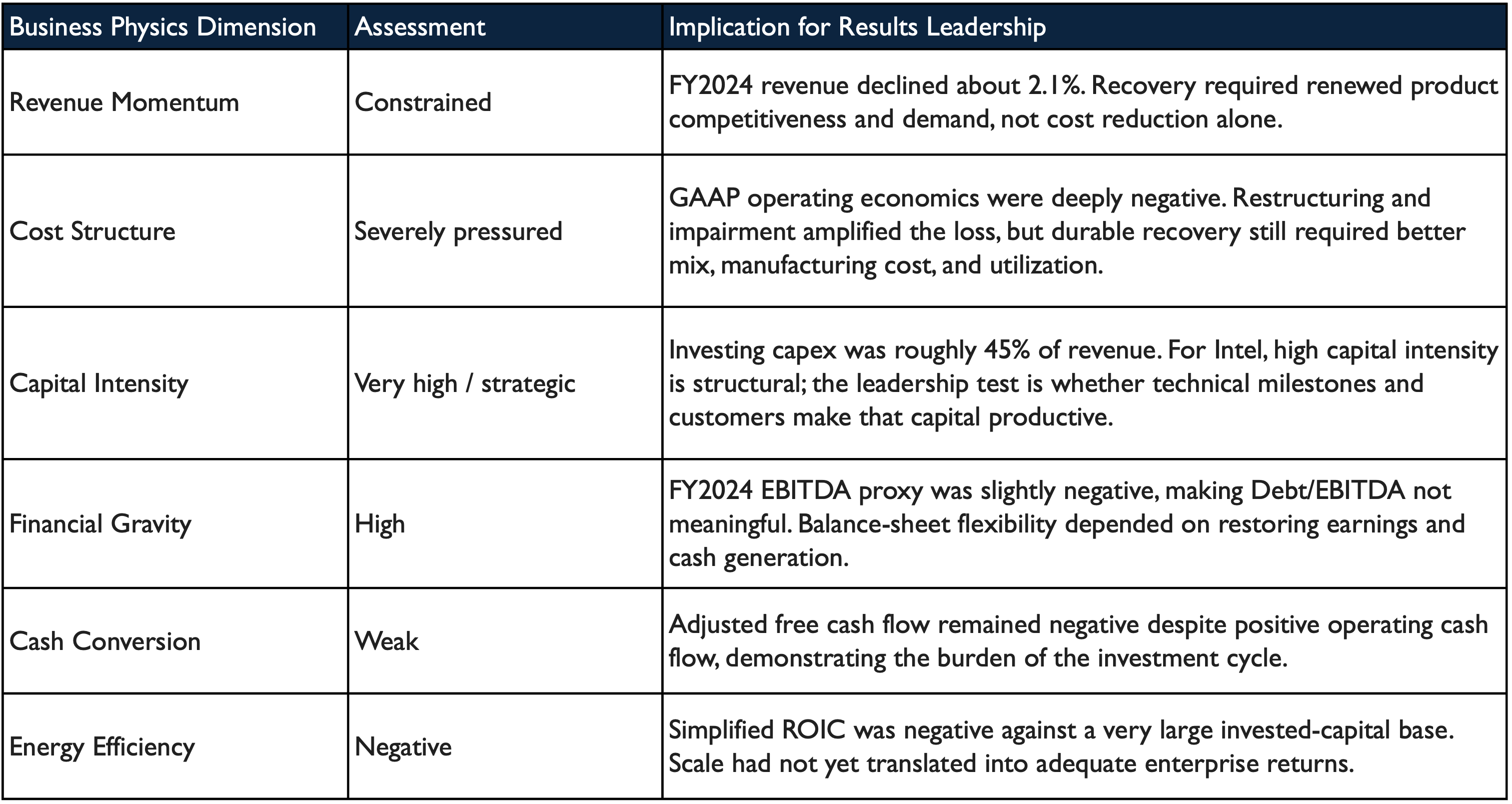
Taken together, the BPPA™ dimensions show that Intel’s problem was not capital intensity by itself. Capital intensity is intrinsic to an integrated semiconductor manufacturer. The problem was the productivity of that capital: whether investments in process technology, fabs, products, and ecosystem capabilities could produce customer commitments, utilization, operating leverage, cash generation, and adequate returns.
Scene Three — Reframing Intel’s Challenge Through Enterprise Conversion

The original analysis reached an important conclusion: Intel did not have a vision problem; it had a conversion problem. The retrospective BPPA™ sharpens what that means.
Intel was attempting several transformations at once: defend x86 while enabling heterogeneous compute; rebuild manufacturing competitiveness while developing an external foundry business; reduce structural cost while protecting engineering capability; and restore margins while funding advanced process technology.
The strategic challenge was therefore not merely to execute more initiatives. It was to create a reliable conversion system across the enterprise:
Intel’s enterprise conversion system must connect strategic focus with technical execution, customer adoption, manufacturing utilization, operating leverage, cash generation, and ultimately, capital returns.
This chain changes how Intel’s assets should be interpreted. A process-node milestone matters because it enables competitive products and credible foundry offerings. Customer commitments matter because they improve utilization. Utilization matters because it can improve manufacturing economics. Those economics matter because they determine whether Intel’s capital base generates sustainable cash and returns.
Hartley’s problem-solving logic remains useful here because it forces leadership to define the constraint rather than confuse activity with progress. Blue Ocean Strategy remains useful where Intel can differentiate through trusted domestic and allied manufacturing, open platforms, advanced packaging, and predictable economics. But neither framework substitutes for disciplined sequencing and measurable conversion.
Intel ERRC Grid — Reframing Semiconductor Leadership
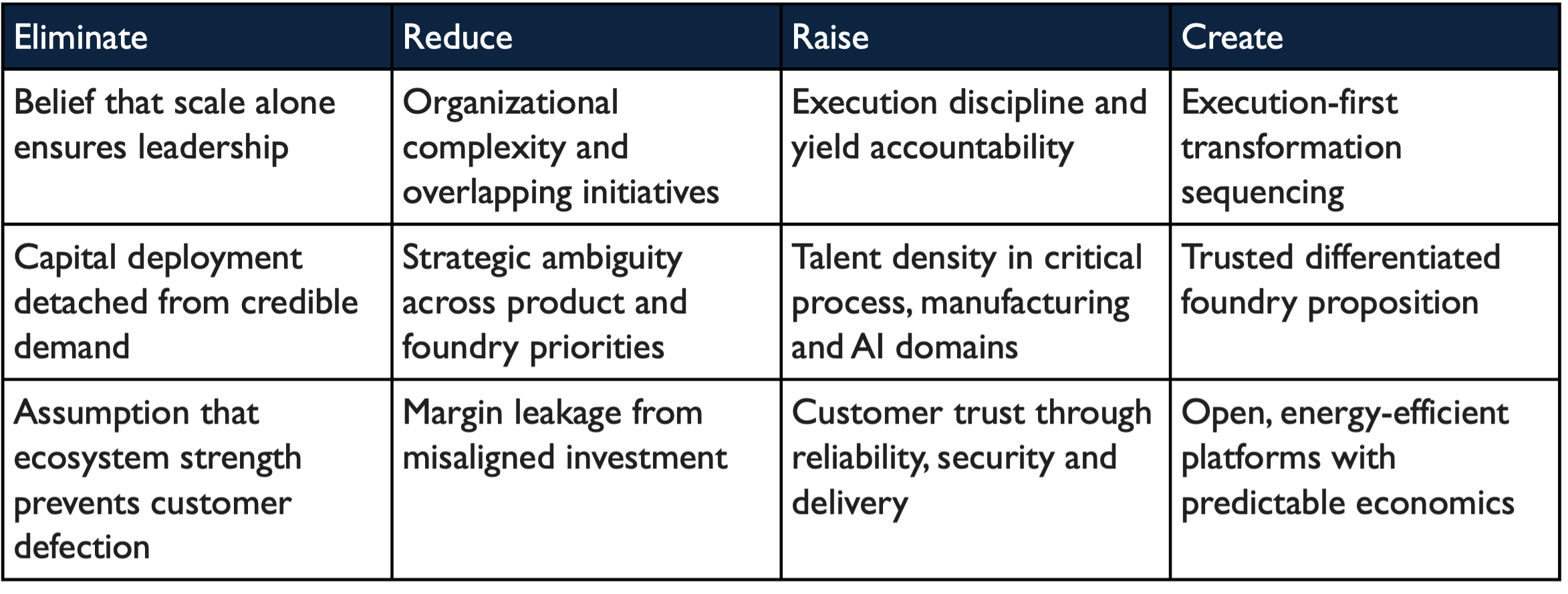
The ERRC framework reframes Intel's transformation around a more disciplined operating logic: scale must follow credible demand, investment must produce measurable economic returns, and technical progress must convert into customer trust and execution reliability. Reducing complexity and margin leakage creates room to strengthen execution discipline and critical talent, while new foundry and platform propositions must demonstrate predictable economics. The leadership challenge is to sequence transformation so that execution, customer adoption, manufacturing utilization, and capital returns reinforce one another — not simply to invest more or innovate faster.
Scene Four — A Realistic and High-Confidence Path Forward

Intel’s transformation required sequencing to replace simultaneity and capital productivity to become an explicit leadership discipline. Five moves follow from the integrated evidence:
1. Sequence the Transformation
Concentrate leadership attention on the few technical and commercial milestones that unlock subsequent stages of the system. Fewer priorities should carry clearer accountability.
2. Protect Critical Talent Density
Cost reduction should preserve the engineering, process, manufacturing, AI, packaging, and customer-facing capabilities on which execution depends.
3. Anchor Foundry Capital to Customer Evidence
Capital deployment should increasingly follow credible demand, customer commitments, technical readiness, and utilization pathways rather than scale as an objective in itself.
4. Convert Technology Milestones into Economic Milestones
Node progress, packaging capability, and product launches should be evaluated through the downstream outcomes they enable: adoption, utilization, margin, cash flow, and return on capital.
5. Rebuild Trust Through Reliability
Product quality, security, predictable roadmaps, yield, and delivery cadence are enterprise assets. Reliability strengthens customer confidence and improves the probability that technical progress converts into commercial value.
Closing Insights — From Execution to Enterprise Conversion
Intel entered 2026 at an important inflection point. Leadership was narrowing priorities, reducing structural cost, strengthening financial discipline, and showing signs of improved operating execution. Yet the enterprise economics still reflected the weight of a capital-intensive transformation whose returns had not been fully realized.
The defining Results Leadership challenge was therefore no longer simply whether Intel could invest, innovate, or restructure. It was whether the company could create an increasingly reliable conversion system—turning strategic focus into technical execution, technical execution into competitive products and customer commitments, and those commitments into manufacturing utilization, cash generation, and sustainable returns on invested capital.
Intel’s scale, ecosystem, manufacturing assets, and technology portfolio remained significant strategic capabilities. But those capabilities would create enduring enterprise value only if leadership could make the system connecting them increasingly productive.
In semiconductors, execution is necessary. Conversion is what makes execution economically durable.
About Results Leadership
Averroes Results Leadership examines how leadership decisions, organizational capabilities, operating models, and technology combine to produce—or constrain—enterprise results.
Published by Averroes Business & Technology, LLC, the publication uses evidence-based analysis to connect strategy, execution, and measurable performance across Results Leadership in Business and Results Leadership in Government.
Business analyses incorporate the Business Physics Performance Assessment (BPPA™) to examine the underlying economics that reinforce—or constrain—sustainable performance.
Amir A. Moore, Founder & CEO of Averroes Business & Technology, serves as Publisher, with Lauren Floyd serving as Writer & Editor, helping shape each issue for clarity, rigor, and executive relevance.