


From the Editor
For public institutions, performance is ultimately measured by the ability to sustain the mission people depend upon—even as the organization itself changes.
The Social Security Administration operates at the intersection of extraordinary mission responsibility and growing organizational complexity. Modernization, fiscal pressure, workforce capacity, technology, governance, and operational risk cannot be managed independently when millions of Americans depend on the agency for consistent and reliable service.
This inaugural issue of Results Leadership in Government examines SSA through the lens of Mission Continuity: how leadership integrates strategy, resources, technology, workforce, governance, and execution to sustain public trust while transforming the enterprise.
The leadership question is whether SSA can modernize while preserving the continuity, reliability, and public trust its mission requires.
— Lauren Floyd, Writer & Editor
Introduction – When Mission Complexity Challenges Operational Continuity

Every month, millions of Americans receive a reminder that government is working — a retirement benefit that helps pay the mortgage, disability assistance to provide stability during difficult moments, survivor benefits that preserve security after loss. Behind each transaction is every citizen’s expectation that the system will function accurately, consistently, and without interruption. Most people never think about what makes that possible.
Unlike private companies, public institutions rarely have the luxury of pausing operations while they reinvent themselves. Airlines can reduce routes; manufacturers can suspend production lines. Government agencies entrusted with essential public services must modernize while continuing to fulfill their mission every single day — a balancing act that has become one of the defining leadership challenges of the modern public sector.
The Social Security Administration (SSA) offers a compelling example. Agencies like SSA operate at a level of complexity that rivals the world’s largest enterprises, yet its mission is straightforward: administer retirement, survivor, disability, and Supplemental Security Income programs while providing high-quality service to the American public. Today the agency serves more than 330 million Americans across every stage of life, from the Social Security number issued at birth, through the earnings record built over a career, to the disability, survivor, and retirement benefits that follow.
This large benefit-delivery agency’s strategic plan frames its long-term direction around equity, accessibility, an improved customer experience, and the removal of systemic barriers to participation while its annual performance plan operationalizes that direction around timely, accurate service delivery. Together, these statements describe a mission that has held steady even as the operating environment around it has changed repeatedly. Coordinating this mission requires managing massive financial responsibilities, operating an extensive nationwide service network, maintaining decades of accumulated technology investments, and safeguarding information affecting virtually every American household.
From a public perspective, success looks deceptively simple: claims are processed, benefits arrive, questions are answered, trust is preserved. Yet those visible outcomes represent only the final expression of thousands of interconnected operational decisions occurring throughout the enterprise every day. The real leadership challenge exists beneath the surface.
So, how do leaders modernize critical systems without disrupting ongoing operations? How do they strengthen cybersecurity while improving customer experience? How do they sustain workforce capability during demographic change, and invest for tomorrow while remaining accountable for today’s performance?
This edition evaluates SSA using Averroes’ Enterprise Performance Assessment Model (EPAM™), an evidence-based framework built around four analytical lenses:
The Seven Physics of Enterprise Performance: strategic, financial, investment, operational, governance, risk, and sustainability
An Evidence Translation Framework that converts published audit, oversight, and performance findings into comparable scores
A Risk Concentration review drawn from the agency’s own authoritative oversight sources
An Engagement Recommendation framework that turns findings into suggested next steps for leadership
Collectively, these lenses suggest SSA’s current position is not primarily a story of mission drift or declining public relevance. Instead, the evidence points toward a mature enterprise whose greatest leadership question is whether every part of the organization — finance, technology, operations, governance, and risk — is advancing in alignment, and whether the evidence needed to confirm that alignment has been fully assembled. Because when public trust depends on uninterrupted mission delivery, leadership becomes more than strategy. It becomes operational discipline.
Scene One – The Agency and the Evolution of Its Operating Model

Private companies compete for customers — government agencies sustain public trust. Every successful interaction reinforces that confidence; every operational failure places it at risk. Although the environments differ, both face similar leadership responsibilities: allocating finite resources, prioritizing competing investments, managing organizational risk, developing talent, modernizing technology, and continually improving performance while meeting stakeholder expectations.
For 90 years, SSA has anchored a central piece of the American social contract — administering the nation’s retirement, survivor, disability, and income-support programs through eras of paper-based processing, mainframe modernization, call-center expansion, and today’s shift toward digital self-service
Millions of customer interactions occur annually across digital platforms, field offices, telephone service centers, payment systems, partner organizations, and administrative operations. Every transaction depends on technology, people, governance, policies, and financial stewardship working together with extraordinary consistency.
Most citizens never witness this complexity because successful operations are intentionally invisible — and that invisibility is itself a measure of performance. The absence of disruption often reflects years of disciplined planning, governance, investment, and leadership rather than the absence of challenges. Yet invisibility can also create a false assumption: that if an organization keeps delivering results, its underlying systems must be equally healthy. Experience suggests otherwise. Operational performance is rarely determined by the absence of problems; it is determined by an organization’s capacity to recognize emerging pressures before they affect mission outcomes.
This distinction matters most in public institutions, where leadership decisions often produce consequences measured over years rather than months. Deferred modernization increases technical debt. Delayed workforce planning erodes institutional knowledge. Incremental cybersecurity gaps become enterprise risks. Budget decisions made today shape operational resilience several fiscal years later. Viewed individually, these issues may look manageable, but viewed collectively, they reveal the operating health of the enterprise itself.
That is why organizational performance cannot be measured by outputs alone. High-performing organizations also demonstrate alignment:
Leadership priorities reinforce operational execution.
Technology investments support mission delivery.
Financial decisions strengthen long-term capability.
Governance improves decision quality.
Risk management becomes proactive rather than reactive.
That raises the question this edition is built to answer: how can leaders distinguish between routine operational pressures and those that signal deeper organizational challenges? The answer begins by looking beyond individual performance measures and examining the enterprise as an integrated system.
Scene Two – The Enterprise Physics of a Federal Benefit-Delivery Agency

As with the evolution of the Business Physics Assessment Model used for private-sector enterprises, the Enterprise Performance Assessment Methodology will continue to mature as additional federal agencies are assessed and new evidence patterns emerge.
Every organization tells a story. Financial statements may be chapter two; technology investments chapter five; cybersecurity assessments, workforce trends, modernization initiatives, customer service performance, Inspector General reports, and strategic priorities each contribute additional chapters. Individually, these indicators provide valuable information. Collectively, they reveal how well the enterprise is functioning.
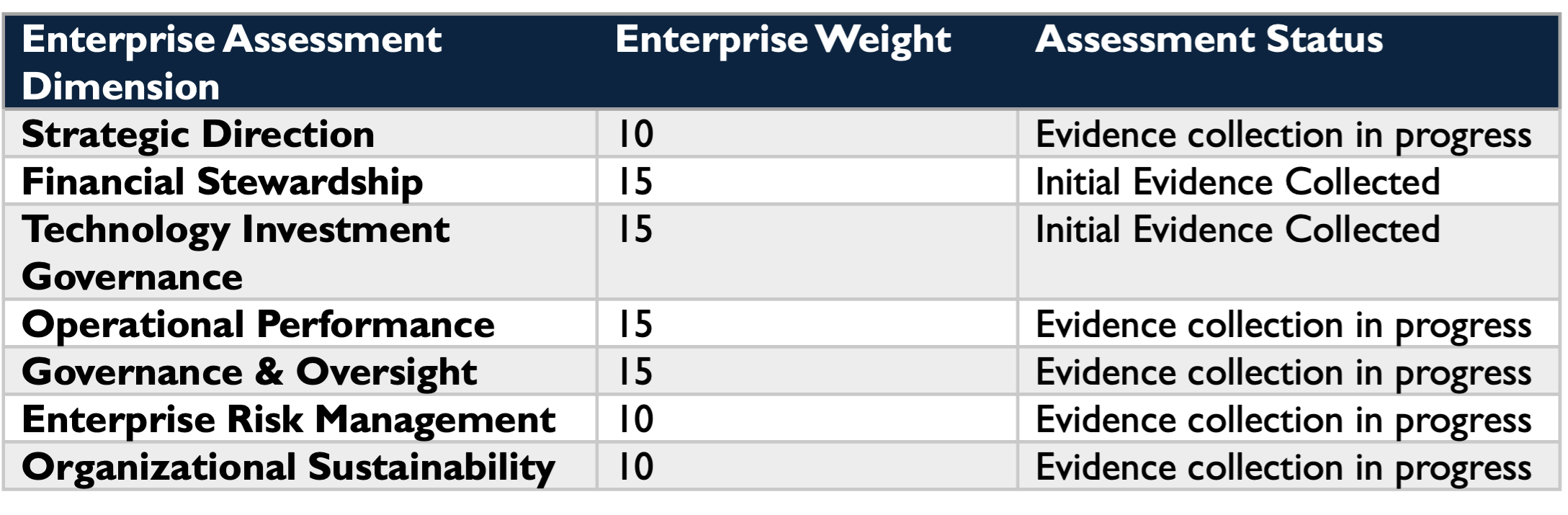
Using the EPAM™ framework, SSA was evaluated across the Seven Physics of Enterprise Performance:
Enterprise Assessment Status – 2025
Source: EPAM™ Engagement Recommendation Framework, SSA FY 2025 assessment.
Assessment Status: This publication is based on an evidence-based review of authoritative federal sources. At the time of publication, the Enterprise Performance Assessment Methodology (EPAM) evidence repository had been partially populated. Quantitative dimension scores will be generated after all evidence domains have been completed and independently assessed.
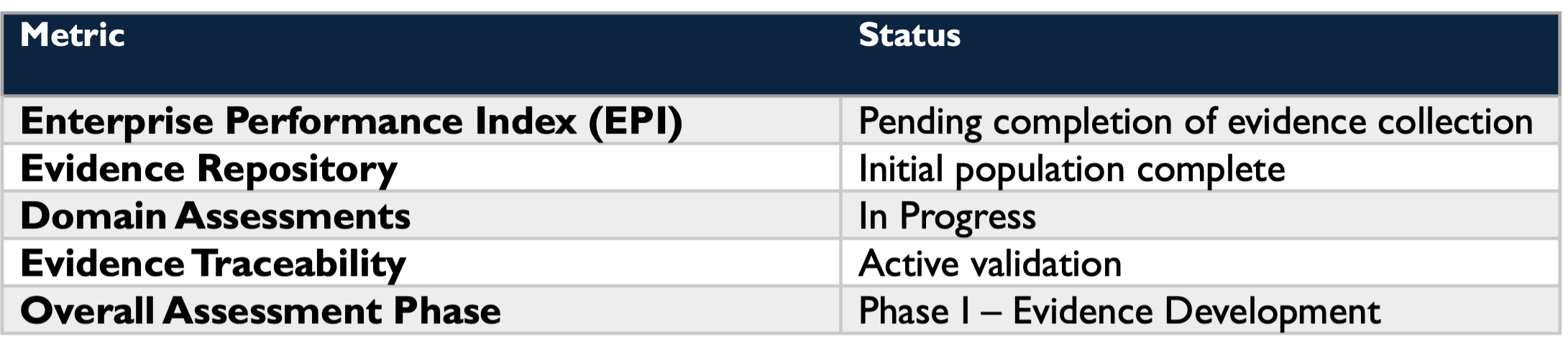
Assessment Maturity
Source: EPAM™ Engagement Recommendation Framework, SSA FY 2025 assessment.
The Enterprise Performance Assessment Methodology (EPAM™) is currently in its evidence development phase. While the Social Security Administration’s publicly available financial and technology investment information has been analyzed, additional governance, operational, risk, and sustainability remains under evaluation. Consistent with Averroes’ evidence-based methodology, enterprise performance scores are published only after each dimension has been independently assessed and fully traceable to authoritative sources. What is already reported paints a picture of scale:
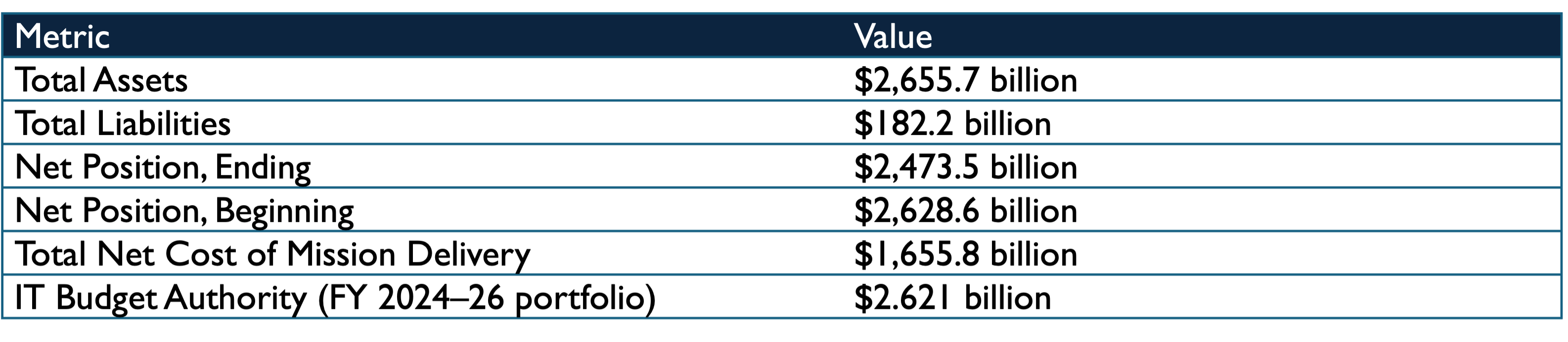
By the Numbers FY 2025
Source: SSA FY 2025 Agency Financial Report, pp. 26, 51; FY 2026 SSA Limitation on Administrative Expenses Congressional Budget Justification, p. 108.
These figures put a scale on the complexity described above, but scale alone does not answer the leadership question this edition returns to. Net position declined by roughly $155 billion over the course of the year — a movement that could reflect routine program financing dynamics or an early signal worth monitoring. Distinguishing between the two is precisely the discipline an evidence-based, enterprise-wide view is built for. It is also worth noting plainly that, as of this edition, the full evidence base needed to score SSA across governance, operations, and risk — not just finance and technology — is still being assembled. That is itself consistent with this edition’s argument. Reading the enterprise responsibly means collecting evidence before forming a conclusion, not the other way around.
The publicly available evidence surrounding the Social Security Administration presents an encouraging picture in several respects:
Continuous delivery of one of government’s most consequential public services while managing extraordinary operational complexity.
Financial stewardship remains supported by extensive oversight mechanisms.
Significant modernization initiatives improve digital service delivery.
Leadership has emphasized cybersecurity, customer experience, technology modernization, and workforce transformation as strategic priorities
Independent oversight reflects an organization actively identifying and addressing areas requiring continued attention rather than avoiding difficult conversations
These are all characteristics commonly associated with mature enterprises.
At the same time, future success will depend less on defining new strategic objectives than on maintaining alignment across the enterprise as modernization accelerates. Transformation introduces new complexity: legacy systems continue operating alongside modern platforms, workforce transitions reshape institutional knowledge, technology investments create new dependencies, and cybersecurity expectations keep evolving.
Each initiative strengthens one part of the organization while increasing the importance of coordination across all the others. Leadership, therefore, becomes less about launching individual initiatives and more about orchestrating an enterprise in motion.
In SSA, transformation is clearly occurring. The more important concern is whether every element of the enterprise is advancing together since history shows that organizations seldom experience significant disruption from a single failure. More often, disruption occurs when multiple small misalignments reinforce one another until operational resilience gradually erodes. The evidence suggests the Social Security Administration understands this reality; the next question is where the greatest opportunities — and the greatest risks — are beginning to concentrate.
Scene Three – Where Risk is Concentrating

High-performing organizations rarely decline overnight. More often, they experience subtle shifts that become visible only when viewed together: a modernization project falls behind schedule, an experienced employee retires without a successor, technical debt grows incrementally, cybersecurity requirements evolve faster than legacy infrastructure, customer expectations rise while budgets remain constrained. Individually, none of these developments necessarily threatens mission success. Collectively, they begin to shape an organization’s future operating environment.
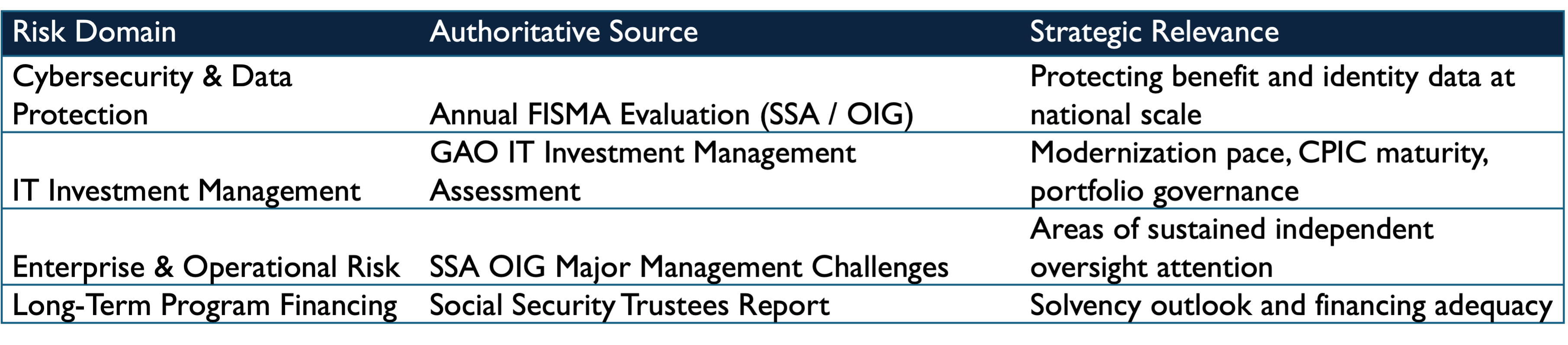
SSA’s own authoritative oversight sources point to where structural pressure is most likely to concentrate:
Risk Concentration — Authoritative Sources
Source: EPAM™ Authoritative Source Register.
These are not isolated compliance categories — each source tracks a domain of risk that sits directly inside SSA’s core operating model. Its mission remains clear, and leadership priorities are well defined; modernization efforts continue to move forward. Yet the complexity of managing simultaneous transformation across technology, operations, workforce, finance, and service delivery introduces a different leadership challenge. The question is no longer whether improvement initiatives exist, but whether they remain synchronized because large organizations rarely struggle from failing to identify the right priorities. More often, they struggle when every priority competes for the same limited organizational capacity, all while leaders prepare the workforce for new ways of operating without losing decades of institutional knowledge.
Technology modernization, for example, cannot be viewed solely as an IT initiative: new digital platforms influence customer experience, affect workforce training, reshape business processes, introduce new cybersecurity considerations, alter governance requirements, and create current and future financial commitments. The same principle applies to workforce transformation — federal agencies across government are confronting an unprecedented transfer of institutional knowledge as experienced employees retire. Replacing positions is relatively straightforward; replacing judgment developed through decades of mission experience is considerably harder.
Financial stewardship presents another example. Public institutions are expected to maintain exceptional accountability while continually investing in modernization — objectives that reinforce one another over the long term but often compete in the short term. The financial data introduced in Scene Two shows a $155 billion decline in net position, a nearly $2.7 trillion asset base, and a technology portfolio approaching $2.6 billion which are each, on their own, simply facts about scale. Whether they represent prudent financing of a mission this large, or an early pressure point building beneath strong headline numbers, is not something the figures alone can answer.
That determination depends on surrounding evidence such as audit findings, control assessments, project performance, and workforce trends, much of which has not yet been fully reported or independently corroborated for this fiscal year. The gap between what is known and what is knowable is itself a leadership signal worth watching.
The evidence therefore points toward a broader conclusion: the Social Security Administration does not appear to be confronting a collection of unrelated operational challenges. It appears to be managing the natural complexity of transforming one of the nation’s largest public enterprises while continuing to deliver uninterrupted mission performance. That distinction is significant — future organizational performance will depend less on solving isolated problems than on maintaining alignment across an increasingly interconnected enterprise.
Scene Four – Diagnosing the Leadership Problem

When organizations experience operational disruption, the immediate response is often to search for a technology failure, a funding shortfall, a staffing challenge, a cybersecurity incident-usually one single source. While these factors certainly matter, they rarely explain the whole story. Complex organizations seldom fail because one component stops working but when the relationships between components begin to weaken, one of the most consistent observations across organizational performance.
Technology alone cannot compensate for unclear governance, financial resources cannot overcome fragmented execution, and strong leadership cannot sustain long-term success if organizational systems continually work against one another. The challenge becomes integration, not capability.
The Social Security Administration illustrates this reality particularly well despite high public visibility while managing such extensive operational complexity. Every strategic initiative —digital modernization, cybersecurity, workforce development, customer service, or operational efficiency — ultimately depends on thousands of daily decisions made across the enterprise. Those decisions cannot rely solely on policy; they require alignment between strategy and execution, investments and priorities, technology and mission, and between leadership expectations and operational reality.
When those relationships remain healthy, organizations become remarkably resilient, adapting to changing conditions without sacrificing mission performance. When those relationships weaken, even successful organizations begin experiencing friction via progress slows, decision cycles lengthen, multiplied dependencies, and increased operational risk, often while traditional performance indicators continue to look healthy. That is why mature organizations increasingly focus on organizational health rather than outputs alone. Outputs describe what happened; organizational health explains why it happened and whether similar performance can realistically be sustained.
For public institutions, this distinction carries real weight. Citizens rarely judge government by the quality of its strategic plans — they judge it by the consistency of its service. Mission continuity ultimately resides not within any single modernization initiative, technology platform, or budget cycle, but within an enterprise capable of adapting continuously while preserving the confidence placed in it by the people it serves.
That observation extends well beyond the Social Security Administration to other organizations that succeed over the next decade. They will not necessarily be pursuing the greatest number of initiatives — they will be the organizations capable of ensuring those initiatives strengthen the enterprise together. Because transformation, by itself, is not the objective. Sustained organizational performance is.
Scene Five – Suggested Interventions — Priority Engagement Areas

Diagnosis is only useful if it leads somewhere. Averroes’ Engagement Recommendation Framework translates each Enterprise Physics dimension into a suggested area of leadership focus, because diagnosis is only useful if it leads somewhere. Since SSA’s FY 2025 assessment remains in progress, the following findings represent starting priorities rather than final prescriptions each sharpened as the underlying evidence is completed.
Suggested Interventions by Dimension
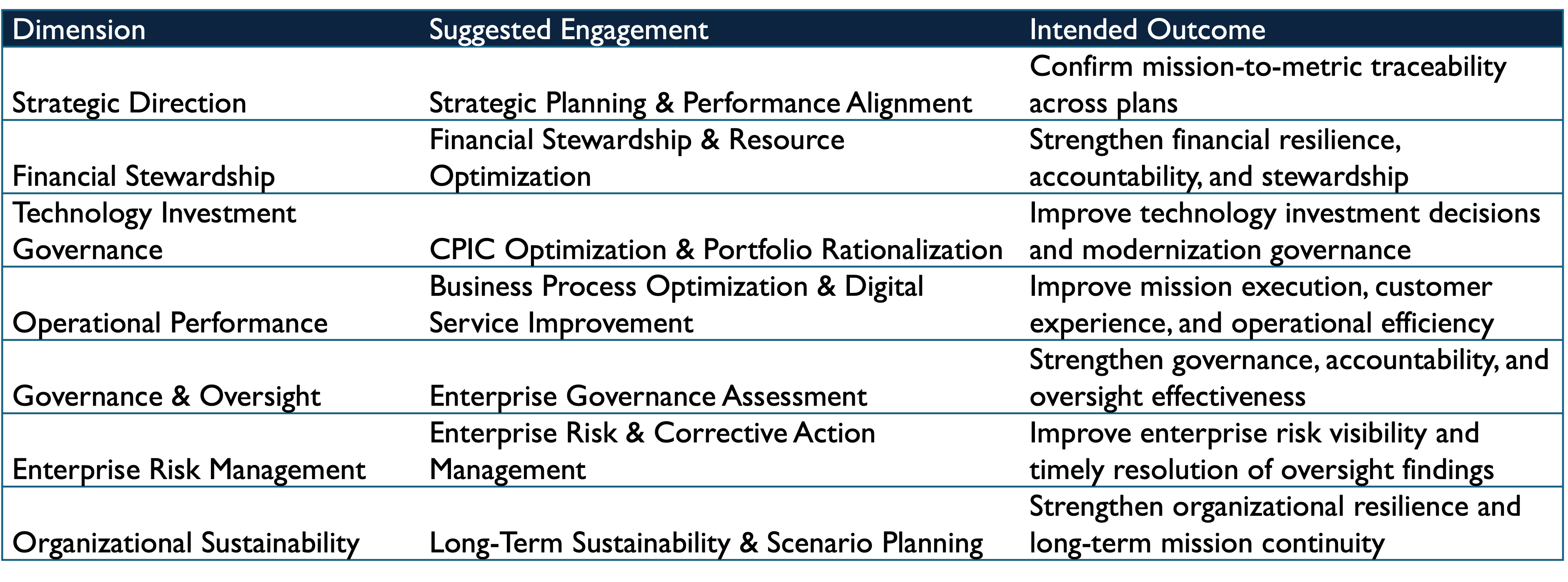
Source : EPAM™ Engagement Recommandation Framework.
Transformation is often described as a destination. In reality, it is a capability. Organizations do not transform simply because they implement new technology, redesign processes, or reorganize reporting structures — they transform when those changes become part of how the enterprise consistently operates. That distinction matters most within government where public institutions cannot suspend mission delivery while they modernize. Leadership therefore balances two responsibilities at once: delivering today’s mission and preparing the organization for tomorrows. Neither can succeed without the other.
The publicly available evidence suggests the Social Security Administration is moving deliberately in this direction. Investments in digital services improve accessibility while reducing administrative burden. Cybersecurity initiatives strengthen public confidence in the protection of sensitive information. Workforce planning seeks to preserve organizational capability while preparing employees for changing technologies and service models. Financial stewardship continues supporting long-term modernization while maintaining accountability for taxpayer resources.
Each of these initiatives works in tandem to strengthen the enterprise’s ability to fulfill its mission under increasingly complex operating conditions.
Resilience should not be confused with resistance to change. The strongest organizations are not those that avoid disruption — they are the ones that continuously adapt while preserving the confidence of those they serve. Mission continuity is not achieved by standing still; it is achieved by evolving without losing sight of why the organization exists. That responsibility belongs to every leader.
Scene Six – Sustaining the Transformation

Every generation of public leaders inherits a different operating environment. Previous generations confronted paper-based processes, expanding workloads, demographic change, and the early adoption of information technology. Today’s leaders face artificial intelligence, increasingly sophisticated cyber threats, rapidly evolving citizen expectations, workforce transformation, and accelerating technological innovation. Tomorrow’s leaders will inherit challenges that cannot yet be fully anticipated. The specific issues will change while leadership responsibility remains the same.
Organizations capable of sustaining mission continuity make decisions using evidence rather than assumptions, strengthen governance before crises emerge, invest in organizational capability rather than isolated solutions, and encourage continuous learning. Most importantly, they recognize that leadership extends beyond directing people to shaping systems. When organizational systems remain aligned, people perform at their best; when systems drift apart, even exceptional employees struggle to produce exceptional outcomes.
This observation is especially relevant for mature public institutions such as the Social Security Administration which has spent decades developing processes, governance structures, operational expertise, and public trust that cannot be replicated quickly.
The challenge facing its leaders is therefore not reinvention — it is stewardship: stewardship of public confidence, institutional capability, and mission performance. That responsibility extends well beyond one agency. Every department across the federal government — from health and public safety to environmental protection, national security, veterans’ services, transportation, energy, and financial oversight — depends on the same underlying principle: citizens trust institutions that consistently fulfill their mission. That trust is earned through performance, and performance is sustained through leadership.
As technology continues reshaping the public sector, leadership will increasingly be measured not by the number of modernization initiatives completed, but by whether those initiatives strengthen the organization’s long-term ability to serve its mission. Mission continuity therefore becomes a leadership discipline more than an operational objective — one that every public executive will continue practicing long after today’s technologies have been replaced by tomorrow’s innovations.
Final Insights – When Mission Continuity Becomes Government’s Competitive Advantage
The Social Security Administration does not appear to have a mission problem. Its mission remains among the clearest in government. The evidence instead suggests that its long-term success depends on something less visible but considerably more important: sustaining alignment across an enterprise operating under continual change.
The Enterprise Physics assessment shows an agency of substantial scale: a $2,655.7 billion asset base, a $2.6 billion technology portfolio, and a mission that has held steady across 90 years. But with much of the governance, operational, and risk evidence still needed, a full enterprise score is still being assembled. The risk-concentration review points to four areas already under active independent oversight:
Cybersecurity
IT investment management
Broader enterprise risk
Long-term program financing
The suggested-interventions framework translates those findings into seven starting engagement priorities, one for each Enterprise Physics dimension, to be sharpened as evidence collection continues.
That observation carries implications far beyond one agency. Across government, leaders are being asked to modernize technology, strengthen cybersecurity, improve customer experience, attract new talent, preserve institutional knowledge, increase operational efficiency, and demonstrate measurable stewardship of public resources. Each objective is important, but none can succeed independently — organizational performance emerges from the relationships between them.
This may be the central lesson for public-sector leadership: transformation is not the destination. Mission continuity is. Technology enables it, governance sustains it, financial stewardship supports it, workforce capability strengthens it, and leadership aligns it. When these elements operate together, organizations become more resilient than any individual initiative could achieve on its own. Public trust grows because citizens experience consistency rather than complexity — they simply see government working, which may be the highest compliment any public institution can receive.
For leaders, it represents something deeper: years of disciplined decisions, thoughtful governance, sustained investment, and organizational alignment that rarely attract public attention precisely because they succeed. The most effective public organizations seldom become headlines. They become dependable.
Mission continuity, therefore, should not be viewed as a contingency planning exercise. It is the visible outcome of organizational performance, and organizational performance, in its most enduring form, remains a reflection of leadership.
Financial and technology-investment figures in this edition are drawn from the SSA FY 2025 Agency Financial Report and the FY 2026 SSA Limitation on Administrative Expenses Congressional Budget Justification, as compiled in Averroes’ Enterprise Performance Assessment Model (EPAM™). This assessment remains in progress; governance, operations, and risk evidence for FY 2025 were not yet fully available at the time of publication.
About Results Leadership in Government
Results Leadership in Government is a strategic insight series from Averroes Business & Technology that examines how federal agencies convert mission into measurable, sustained performance. Each edition applies the Enterprise Performance Assessment Model (EPAM™) to publicly available evidence — agency financial reports, congressional budget justifications, GAO and Inspector General findings, and FISMA evaluations — to surface where enterprise alignment is strong and where it is still being built. Findings are translated into suggested engagement priorities using the Averroes Engagement Recommendation Framework.
Amir A. Moore, Founder & CEO of Averroes Business & Technology, serves as Publisher of Averroes Results Leadership, leading the research, analysis, thesis development, and editorial direction for each issue. Lauren Floyd serves as Writer & Editor, helping shape each issue for clarity, analytical rigor, and executive relevance.