


From the Editor
Periods of extraordinary success can obscure a harder leadership question: what happens when the conditions that produced that success begin to disappear?
For Pfizer, the pandemic generated an exceptional financial windfall. But as COVID-era demand receded, leadership faced a different challenge—renewing the company’s growth engine through portfolio strategy, scientific innovation, acquisitions, and disciplined commercialization.
This issue examines that transition through a Results Leadership lens. Pfizer’s long-term advantage will depend not simply on how much it invests in innovation, but on how consistently it can convert scientific ambition into approved therapies, commercial performance, and repeatable growth.
— Lauren Floyd, Writer & Editor
Introduction – Windfall and the Discipline of Renewal

The pandemic created one of the most extraordinary revenue surges in pharmaceutical history.
Few companies benefited more than Pfizer Inc. Its COVID-19 vaccine and antiviral therapy generated tens of billions in revenue and temporarily reshaped the company’s financial profile.
But windfalls create their own strategic challenge.
Temporary revenue spikes rarely translate into durable growth unless leadership can rebuild the economic engine beneath them. As pandemic demand fades, Pfizer now faces the more difficult task: converting a historic moment of success into a sustainable long-term growth platform.
This month’s analysis asks a harder question:
Can Pfizer convert pandemic windfall into platform advantage?
Scene One – The Portfolio Strategy

Pfizer’s strategy today reflects the structure of modern biopharmaceutical competition.
Rather than relying on a single therapeutic category, the company is building a diversified portfolio across oncology, vaccines, rare diseases, and emerging metabolic treatments. This approach recognizes a fundamental reality of the pharmaceutical industry: blockbuster drugs eventually face patent expiration, regulatory pressure, and competitive displacement.
Therefore, sustained performance depends on continuously renewing the pipeline. Recent strategic moves illustrate how Pfizer is pursuing that renewal.
The company has expanded its oncology capabilities through the acquisition of Seagen Inc. while simultaneously supplementing internal research through licensing partnerships with biotechnology innovators.
These initiatives signal a company actively rebuilding its growth engine.
Along with portfolio expansion, the underlying economics must support the strategy to guarantee results.
Scene Two – The Physics of a Biopharmaceutical Engine

Behind every strategy sits an economic engine that determines whether the plan can succeed.
To understand Pfizer’s operating model, we examined the company’s financial structure through the Business Physics framework. Results revealed a business built far less on physical infrastructure than on the productivity of its innovation pipeline.
Key indicators illustrate the structure clearly:
R&D intensity: ~16.7% of revenue
Capex intensity: ~4.2% of revenue
Capex-to-D&A ratio: ~0.40x
Interest coverage: ~10.6x
These metrics confirm capital flows primarily into scientific discovery, clinical trials, licensing partnerships, and intellectual property development, not factories-- a defining reality of the pharmaceutical industry.
Innovation is the economic engine. But innovation alone does not guarantee results.
The Innovation Conversion Gap
In pharmaceutical markets, the journey from discovery to commercialization is long and uncertain. Thousands of potential molecules enter research pipelines, yet only a small fraction ultimately become approved therapies.
This dynamic creates what can be described as an Innovation Conversion Gap — the distance between research investment and successful commercialization.
For Pfizer Inc., the challenge is not simply funding research but converting scientific programs into therapies that achieve regulatory approval, physician adoption, insurance reimbursement, and sustained patient demand.
Each stage introduces risks including:
clinical trial outcomes
regulatory review
competitive therapies
formulary access.
When conversion succeeds, pharmaceutical companies generate extraordinary value. When it fails, years of research investment may never produce revenue.
Which raises the next question: Where does risk concentrate inside that conversion process?
Scene 2.75 — Risk Heat Map
Before leaders’ implement transformation, they must first determine where pressure is most concentrated.
Risk disclosures in pharmaceutical filings are extensive, but their true value lies in identifying patterns. When the most material risks cluster around a company’s economic engine, the challenge is rarely episodic — it is structural.
A review of Pfizer’s Form 10-K reveals that the company’s most significant exposures sit directly inside its innovation pipeline.
Pfizer Risk Concentration Profile
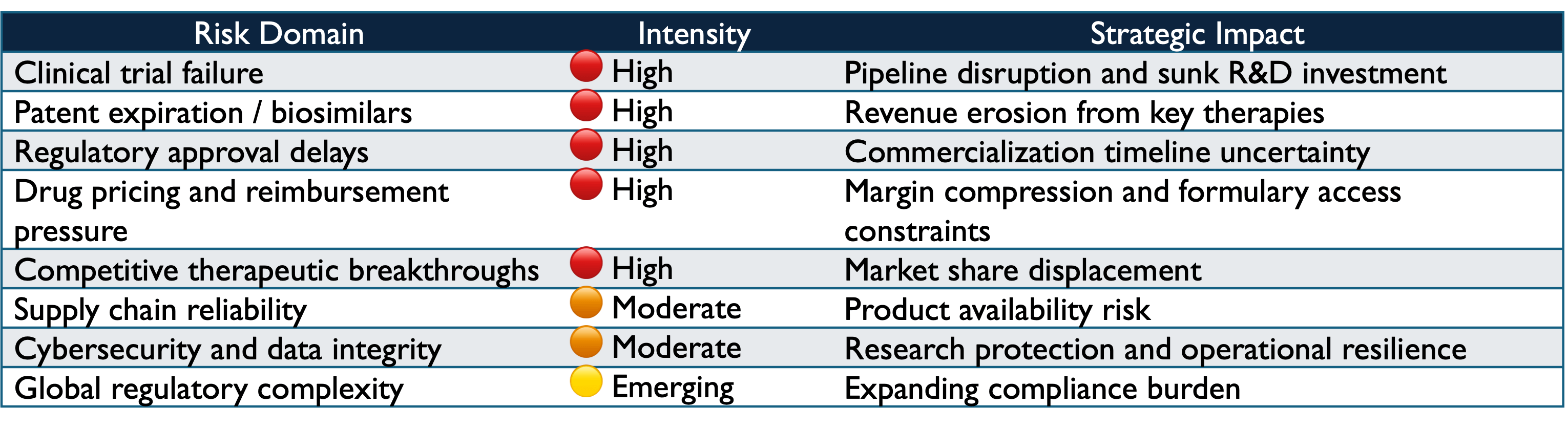
The clustering is telling.
Four of the highest-intensity risks sit directly inside the innovation commercialization pathway — the same pathway identified in the Innovation Conversion Gap.
The strategic challenge therefore becomes clear: Pfizer must not only innovate but consistently convert innovation into revenue-producing therapies.
Diagnosis leads naturally to the next step: disciplined problem solving.
Scene Three – Applying Hartley’s Strategic Problem-Solving Framework
Hartley’s 7-Step Strategic Problem-Solving Framework clarifies the challenge.
Define the real problem: Pandemic revenue is declining while future growth engines remain in development.
Quantify the impact: Portfolio renewal must offset lost COVID-era revenue.
Identify root causes: Dependence on successful clinical development and regulatory approval.
Generate options: Expand internal R&D, acquire innovation platforms, or license promising molecules.
Evaluate trade-offs: Each path carries scientific and financial risk.
Decide: Pfizer has chosen a hybrid model combining internal research, acquisitions, and licensing partnerships.
Execute: Convert pipeline innovation into commercially successful therapies.
The constraint is not strategic vision.
It is innovation conversion discipline.
Scene Four: Sequencing the Renewal

Strategic transformations often fail because organizations pursue too many initiatives simultaneously without stabilizing the economic foundation first.
Pfizer’s leadership must now manage a delicate transition — moving from a period of pandemic-driven revenue toward a future defined by oncology, rare disease, and platform-based innovation, while simultaneously sustaining current revenue streams and investing aggressively in the therapies that will define the next decade of growth.
Tiered Execution Model
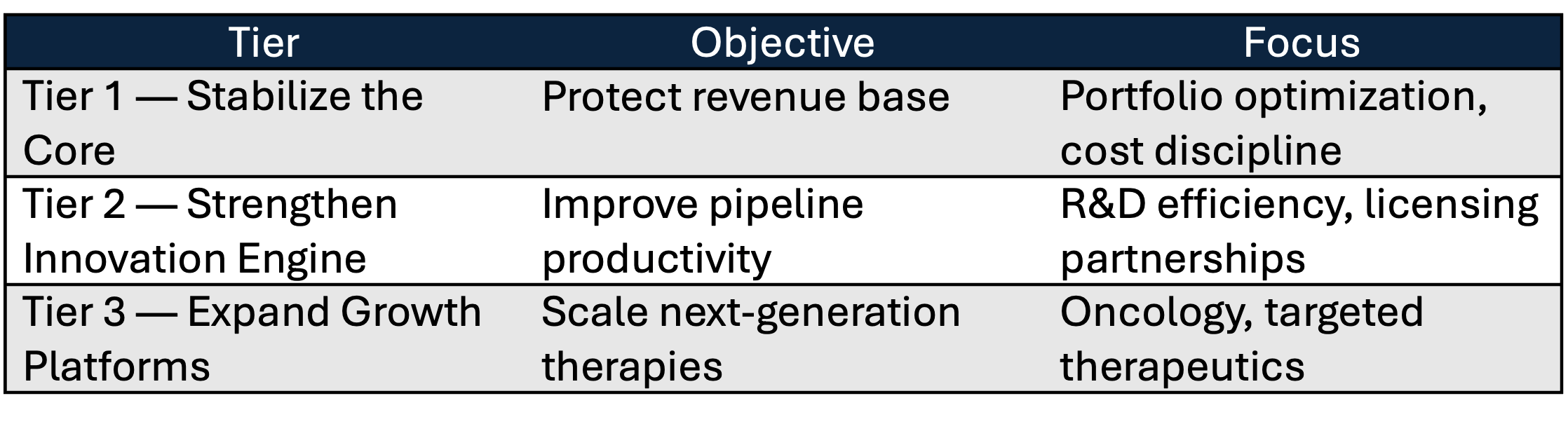
Sequencing becomes essential. Expansion without it risks compounding complexity faster than revenue can absorb it.
Scene Five – Blue Ocean Reframe

Sequencing stabilizes the engine. Differentiation determines where the company drives it.
Traditional pharmaceutical competition often revolves around pipeline size. Companies measure success by the number of drug candidates under development and the scale of research investment.
However, this dynamic creates an innovation arms race. Blue Ocean Strategy challenges leaders to rethink that paradigm.
For Pfizer, the question becomes:
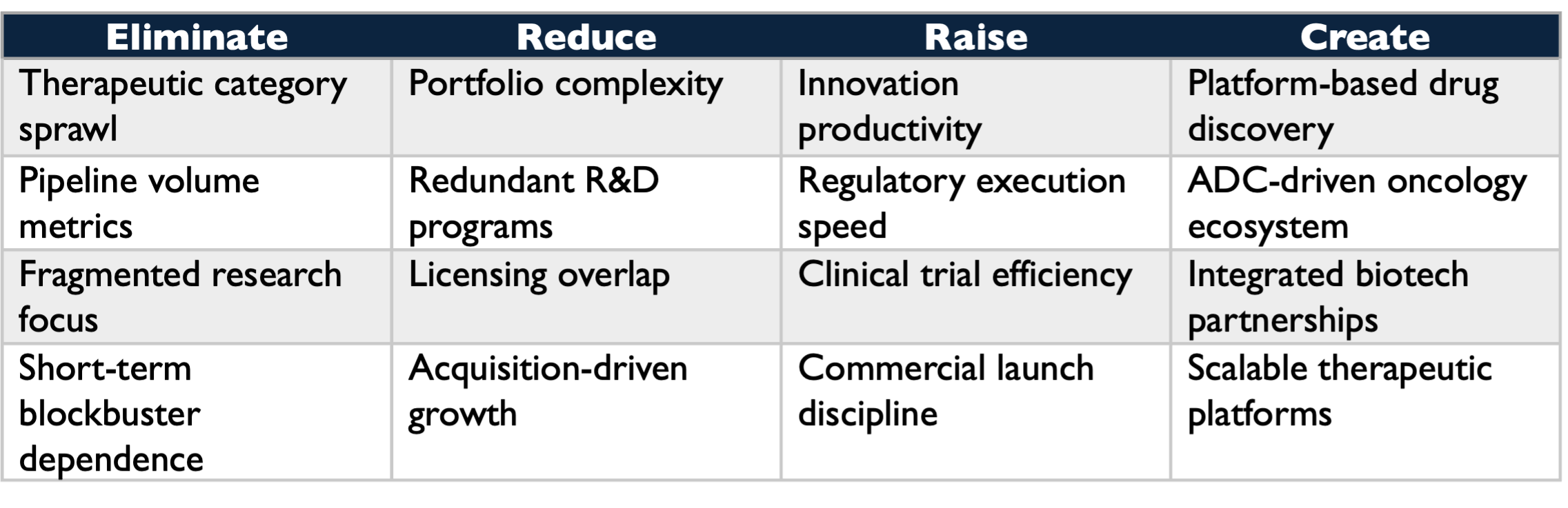
Is advantage achieved by expanding the pipeline or by building innovation platforms capable of generating multiple therapies over time?
ERRC Grid — Strategic Reframe
The Platform Economy of Biopharma
As Pfizer navigates these new processes, a structural shift is underway across the pharmaceutical industry.
Competition is increasingly shifting toward innovation platforms — scientific architectures capable of generating multiple therapies over time.
One of the most important examples is Antibody-Drug Conjugate (ADC) technology, which links a targeting antibody with a powerful cancer-killing agent.
The acquisition of Seagen Inc. positioned Pfizer Inc. at the center of this emerging platform economy.
Platforms transform innovation from isolated breakthroughs into repeatable engines of discovery.
For Pfizer, the opportunity is clear: oncology could evolve from a collection of products into a self-reinforcing innovation ecosystem.
Which leads to the final question: Can the organization execute the strategy?
Scene Six – The Brightline Transformation Compass

Strategy clarity alone does not produce results.
Transformation succeeds only when leadership priorities, operating systems, and organizational incentives align with economic reality.
The Brightline Transformation Compass provides a governance architecture built around four dimensions:
Direction — Prioritize therapies capable of replacing pandemic revenue.
Leadership — Align capital allocation with long-term innovation productivity.
Operations — Accelerate clinical development and regulatory execution.
Culture — Anchor scientific ambition to measurable commercial outcomes.
Alignment across these dimensions determines whether strategy becomes performance.
Closing Insights – The Discipline of Renewal

Pfizer’s position today reflects a familiar pattern in corporate history.
Extraordinary events can produce extraordinary results. The pandemic created one of those moments, temporarily transforming the company’s financial trajectory, but windfalls rarely define a company’s future.
Sustained performance emerges only when leadership converts temporary advantage into a disciplined operating model capable of generating value long after the moment passes.
Pfizer possesses many of the ingredients required for renewal: global commercialization capabilities, deep scientific expertise, and an expanding oncology platform.
Yet the defining variable is not ambition. It is execution.
The companies that endure in the pharmaceutical industry are not those that innovate once, but those that convert innovation into repeatable performance.
Pfizer now stands at that inflection point.
If its innovation platforms generate the next generation of targeted therapies, the company could establish a powerful growth engine for the decade ahead. If those investments fail to convert, the gap between scientific ambition and financial results will widen.
Strategy inspires confidence.
Execution produces results.
Results Leadership demands both.
About Results Leadership
Averroes Results Leadership examines how leadership decisions, organizational capabilities, operating models, and technology combine to produce—or constrain—enterprise results.
Published by Averroes Business & Technology, LLC, the publication uses evidence-based analysis to connect strategy, execution, and measurable performance across Results Leadership in Business and Results Leadership in Government.
Business analyses incorporate the Business Physics Performance Assessment (BPPA™) to examine the underlying economics that reinforce—or constrain—sustainable performance.
Amir A. Moore, Founder & CEO of Averroes Business & Technology, serves as Publisher, with Lauren Floyd serving as Writer & Editor, helping shape each issue for clarity, rigor, and executive relevance.