


From the Editor
Financial restructuring can provide an organization with time, liquidity, and a different capital structure. It cannot, by itself, repair the operating model that created the financial pressure.
Spirit Airlines entered 2025 having completed a major restructuring, yet the underlying challenge remained: aligning its network, fleet, customer proposition, cost structure, and operating capacity with an airline market that had changed around it. When the company returned to Chapter 11 in August, the distinction between financial restructuring and enterprise transformation became increasingly clear.
This issue examines Spirit through that lens. The central Results Leadership question is not simply whether the airline can reduce debt or costs, but whether leadership can redesign the operating economics quickly enough to create a sustainable enterprise.
— Lauren Floyd, Writer & Editor
Introduction – When Financial Restructuring Is Not Enough
Spirit Airlines built one of the most recognizable ultra-low-cost carrier models in the United States: low base fares, high-density aircraft, ancillary revenue, and an operating system designed to keep unit costs low. By 2024, however, the economics that sustained that model were no longer reinforcing one another.
Revenue fell 8.4% to approximately $4.9 billion, operating margin deteriorated to -22.5%, adjusted CASM excluding fuel increased 12.9%, and operating cash flow fell to approximately negative $758 million. Spirit entered Chapter 11 in November 2024, emerged in March 2025 after restructuring its balance sheet, and filed for Chapter 11 again on August 29, 2025.
The second filing changes the leadership question. Spirit’s challenge was no longer simply to lower costs, restore growth, or repair the balance sheet. It was whether the airline could redesign its operating economics so that network scale, fleet commitments, customer value, unit revenue, unit cost, liquidity, and capital structure reinforced one another.
Executive question: Can Spirit redesign the airline’s operating economics faster than shrinking scale, fleet constraints, and liquidity pressure compound?
Scene One – Setting the Stage: The ULCC Paradox

Spirit’s historical advantage came from a tightly integrated economic system. High-density Airbus aircraft, rapid turns, low fares, ancillary charges, and high utilization were intended to spread costs across large volumes of available seat miles. When the system worked, scale reinforced low unit cost, and low unit cost reinforced price advantage.
By 2024, that relationship was under pressure. Operating revenue declined to approximately $4.9 billion from $5.36 billion in 2023. Total revenue per available seat mile (TRASM) fell from 9.63 cents to 9.27 cents, while cost per available seat mile (CASM) increased from 10.52 cents to 11.35 cents. Adjusted CASM excluding fuel increased from 7.06 cents to 7.97 cents.
That divergence matters more than any single cost line. Spirit was earning less revenue per unit of capacity while spending more to produce that capacity. Lower fuel prices were not enough to offset the broader cost pressure.
At the same time, Spirit was changing the customer proposition. New fare products—Go, Go Savvy, Go Comfy, and Go Big—were intended to broaden its appeal beyond the traditional unbundled ULCC experience. The strategic logic was understandable: improve revenue quality and offer more choice. But repositioning the product could not be separated from the economics of the network delivering it.
The Results Leadership issue was therefore systemic. A customer proposition, route network, fleet plan, cost structure, and capital structure that had once reinforced one another were increasingly moving at different speeds.
Scene Two – Escalation: When Shrinking the Airline Raises Unit Cost

Spirit entered 2025 attempting to improve profitability by reducing capacity and realigning the network toward markets where demand and industry capacity were better balanced. The strategy addressed a real problem: not all capacity was economically productive.
Yet the first half of 2025 exposed a difficult operating paradox. In the second quarter, capacity declined 21.9% year over year and traffic declined 24.3%. TRASM improved 2.2% to 9.41 cents, indicating some progress in revenue productivity. But CASM increased 10.4% to 11.61 cents, while adjusted CASM excluding fuel increased 20.2% to 9.03 cents.
Spirit could not shrink its way to economic health unless the cost structure could shrink with the network.
Airlines carry substantial fixed and semi-fixed costs. When capacity contracts faster than those costs can be removed, the remaining seat miles absorb more expense. Spirit itself identified lower capacity as an important driver of higher unit costs. That meant network rationalization and cost restructuring had to proceed together.
Fleet constraints intensified the challenge. Pratt & Whitney GTF engine availability, aircraft lease obligations, maintenance requirements, aircraft sales, and the need to align fleet size with a smaller network reduced strategic flexibility. Fleet decisions were not simply asset decisions; they shaped capacity, reliability, cash requirements, and the economics of every route.
This is the central operating insight of the turnaround: scale was no longer automatically an advantage, but reducing scale without redesigning the cost base could make the economics worse.
Scene 2.5 – The Financial Pulse: Business Physics Performance Assessment (BPPA™)
For this retrospective archive assessment, Averroes applied its Business Physics Performance Assessment (BPPA™) to Spirit’s FY2024 predecessor financial statements. BPPA™ examines how an organization’s financial and operating model translates strategy into enterprise performance across six dimensions: Revenue Momentum, Cost Structure, Capital Intensity, Financial Gravity, Cash Conversion, and Energy Efficiency.
The dimensions are assessed independently and then interpreted as an integrated enterprise system. Spirit requires additional caution because Chapter 11, negative earnings, aircraft leasing, asset sales, and restructuring effects distort conventional leverage and return measures. The purpose is therefore not to rate the airline, but to identify where its underlying economics reinforced—or constrained—its ability to produce sustainable results.
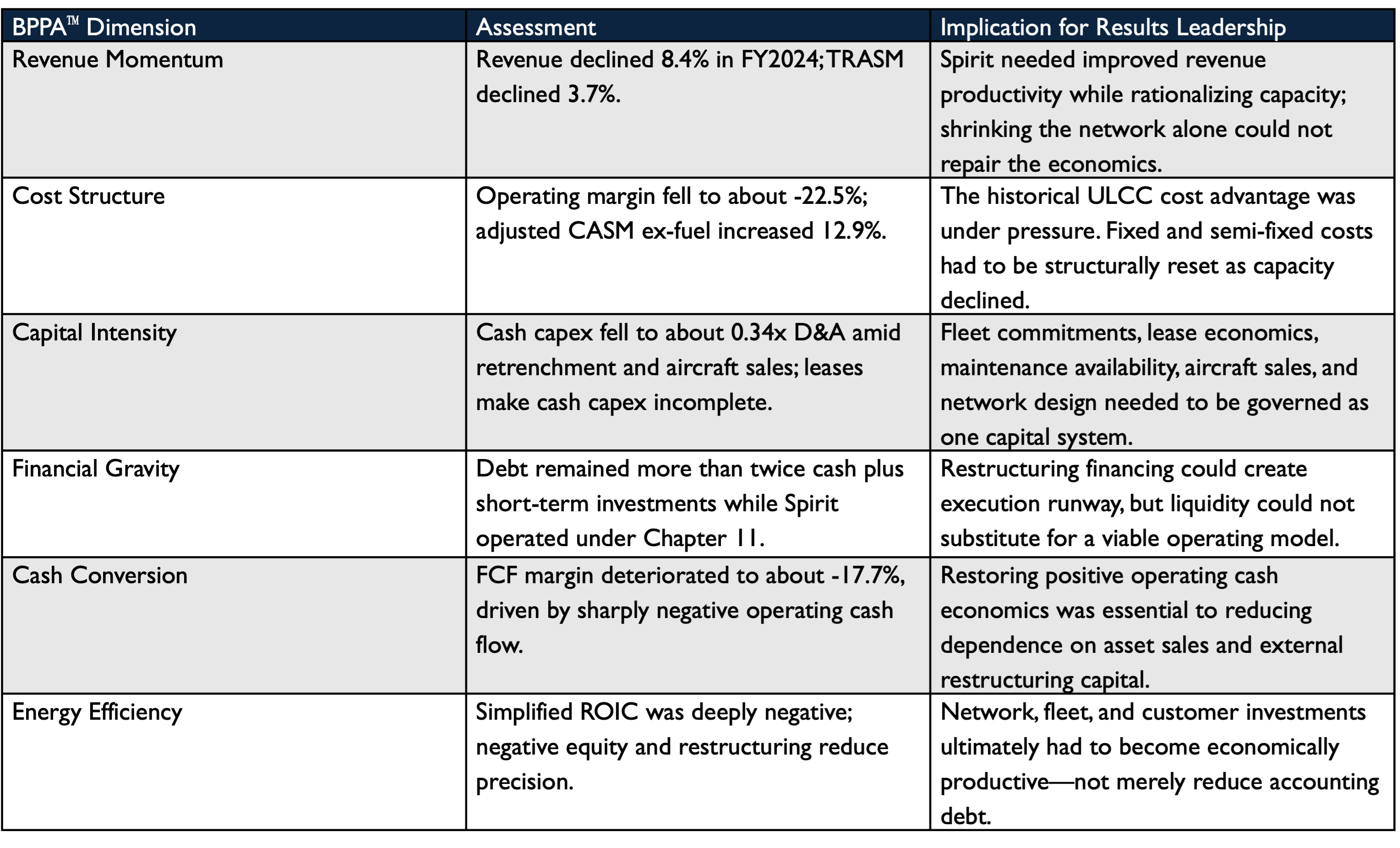
Viewed together, the BPPA™ dimensions show an airline whose financial and operating physics were no longer mutually reinforcing. No strong economic dimension was clearly compensating for weakness elsewhere. Revenue productivity, operating profitability, cash generation, and return efficiency were all under pressure while restructuring altered the meaning of conventional leverage measures.
Scene Three – Turning Point: From Financial Restructuring to Operating-Model Restructuring

Spirit’s first Chapter 11 addressed the capital structure. The company emerged in March 2025 after equitizing approximately $795 million of funded debt and receiving $350 million of new equity investment. Those actions changed who financed the airline and reduced portions of its debt burden.
They did not, by themselves, change the economics of flying the schedule.
The operating evidence available by mid-2025 showed that the turnaround remained incomplete. Q2 operating revenue was approximately $1.02 billion, net loss was approximately $246 million, and operating margin remained negative at 18.1%. Unit revenue improved modestly, but unit cost rose considerably faster.
That distinction separates financial restructuring from operating-model restructuring. Financial restructuring changes debt, equity, liquidity, leases, and creditor obligations. Operating-model restructuring changes the economic engine that must ultimately support whatever capital structure emerges.
Spirit’s August 29 second Chapter 11 filing made that distinction explicit. The company identified network redesign, fleet optimization, cost-structure changes, and alignment of its product proposition with evolving consumer preferences as part of the restructuring agenda.
The Results Leadership implication: balance-sheet repair can create time for transformation, but only operating-model repair can make the enterprise sustainable.
What Must Be Aligned
The evidence points to five interdependent leadership priorities. These are not forecasts of specific outcomes; they are the enterprise relationships the turnaround had to manage.
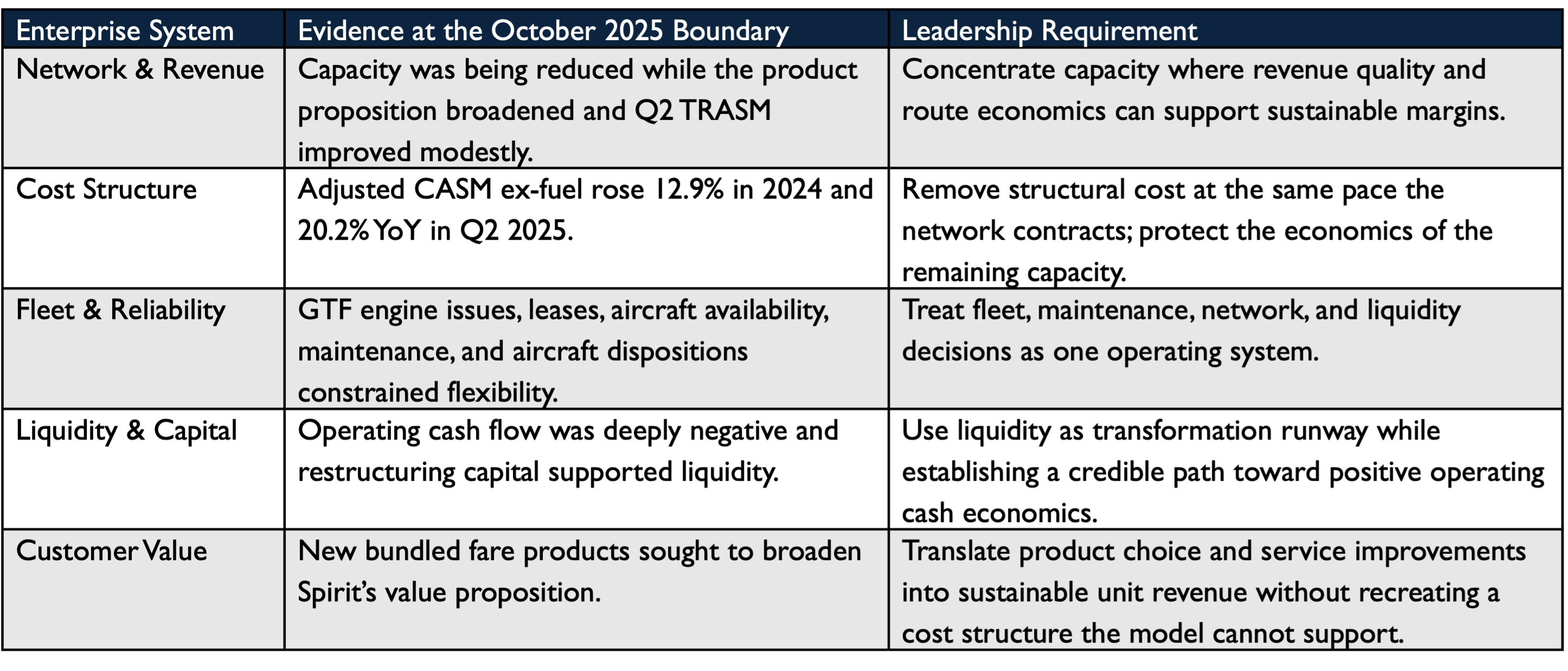
The sequence matters. Growth without unit economics could recreate the old problem. Cost reduction without network and fleet alignment could damage reliability and revenue. Product enhancements without cost discipline could dilute the ULCC advantage. Liquidity without operating improvement could simply extend the period before the next financing constraint.
The turnaround therefore required governance around the relationships among these systems—not isolated initiatives optimized one function at a time.
Scene Four – Resolution: The Flight Path Forward
Spirit’s second restructuring represented a rare opportunity to address the enterprise as a system. The objective was not to recreate the airline that existed before bankruptcy. It was to determine which elements of the ULCC model still created advantage, which had become constraints, and what operating architecture could support a sustainable value proposition.
The first test was economic coherence. Network scale had to fit the fleet. Fleet commitments had to fit demand and liquidity. The cost base had to fit the smaller network. The customer proposition had to generate sufficient unit revenue to support the operating system. And the capital structure had to provide enough flexibility for management to execute those changes.
The second test was execution discipline. In a restructuring environment, decisions about routes, aircraft, staffing, maintenance, pricing, and liquidity are tightly coupled. Leadership therefore needed an integrated view of the consequences of each decision across the enterprise.
The third test was time. Negative cash generation meant the turnaround could not be judged solely by strategic intent. The operating model had to begin demonstrating that improved revenue productivity and structural cost reduction could converge before liquidity pressure narrowed management’s options.
Financial restructuring could create the runway. Operating-model restructuring had to determine whether Spirit could use it.
Closing Insights – The Economics Must Reinforce One Another
Spirit Airlines is the first enterprise-turnaround case in this volume of Results Leadership. Unlike a company whose strong growth offsets incomplete profitability, or a capital-intensive enterprise whose operating economics remain resilient, Spirit entered its second restructuring without a clearly strong economic dimension compensating for weakness elsewhere.
That is why the central lesson extends beyond aviation. Sustainable performance emerges when strategy, operating capabilities, financial structure, and execution reinforce one another. When those relationships break down, improving one variable in isolation can move pressure somewhere else in the system.
For Spirit, the question was not whether low fares still mattered, whether customers valued choice, or whether restructuring could reduce debt. Each mattered. The harder leadership task was making them work together.
Can Spirit redesign the airline’s operating economics faster than shrinking scale, fleet constraints, and liquidity pressure compound?
By the October 2025 evidence boundary, the answer remained unresolved. What the evidence did establish was the nature of the test: the next phase of Spirit’s turnaround would be measured not by completion of a restructuring transaction, but by whether revenue productivity, unit cost, fleet economics, cash generation, and capital structure began reinforcing one another.
About Results Leadership
Averroes Results Leadership examines how leadership decisions, organizational capabilities, operating models, and technology combine to produce—or constrain—enterprise results.
Published by Averroes Business & Technology, LLC, the publication uses evidence-based analysis to connect strategy, execution, and measurable performance across Results Leadership in Business and Results Leadership in Government.
Business analyses incorporate the Business Physics Performance Assessment (BPPA™) to examine the underlying economics that reinforce—or constrain—sustainable performance.
Amir A. Moore, Founder & CEO of Averroes Business & Technology, serves as Publisher, with Lauren Floyd serving as Writer & Editor, helping shape each issue for clarity, rigor, and executive relevance.