


From the Editor
A sound strategy is not enough on its own; the harder leadership challenge is building an organization capable of converting strategic intent into measurable results.
Nu Skin Enterprises illustrates that distinction. Its investments in product innovation, digital engagement, personalized wellness, and global growth reflect where the beauty and wellness industry is moving. Yet the company’s recent performance reveals growing tension between strategic ambition and the economic engine required to support it.
In this issue, we examine that gap through the lens of Results Leadership—looking beyond the strategy itself to the operating model, financial structure, organizational alignment, and execution discipline that ultimately determine whether strategy produces sustainable performance.
The leadership question is whether Nu Skin’s organization can align its capabilities and operating model strongly enough to deliver on that strategy.
— Lauren Floyd, Writer & Editor
Introduction – When Strategy Outpaces the Economic Engine
In the global beauty and wellness industry, growth is often driven by product innovation, brand strength, and expanding distribution networks. Companies that successfully align these elements can scale rapidly, leveraging high-margin products and global demand for personal care and wellness solutions.
Nu Skin Enterprises built its strategy around precisely these dynamics. With a portfolio spanning skincare, nutritional supplements, and connected wellness devices—and a presence across nearly 50 markets—the company appears well-positioned to benefit from long-term industry trends.
But aside from strong strategic positioning, how can Nu Skin Enterprises guarantee performance?
Nu Skin’s recent financial results tell a contrasting story—one defined by declining revenue, compressed margins, and weakening returns on capital. This divergence raises a more fundamental question:
If the strategy is aligned with industry trends, what is constraining performance?
This month’s analysis examines whether Nu Skin’s challenges are rooted in strategy or in the economic structure and execution of the business itself.
Scene One – The Strategy and Business Model

Nu Skin’s blueprint reflects the evolution of the modern beauty and wellness market, where success is increasingly driven by a combination of product innovation, digital engagement, and global reach.
The company operates through a direct selling distribution model, supported by independent Brand Affiliates who promote and sell products through personal and social networks. This model historically enabled rapid expansion, high customer engagement, and strong margins through reduced reliance on traditional retail channels.
At the same time, Nu Skin has expanded its strategy to include:
Connected beauty and wellness devices
Personalized consumer experiences through digital platforms
Growth in emerging markets
Vertical integration through its Rhyz investment arm
These initiatives attempt to modernize a company’s business model and align with broader industry shifts toward digital and personalized wellness.
However, it’s important to remember strategy defines direction—not results.
To understand whether this strategy can succeed, we must examine the underlying economic engine that supports it.
Scene Two – The Business Physics of a Direct Selling Model

Behind every strategy sits a set of economic forces that determine whether the plan can translate into sustainable performance.
Using the Averroes Business Physics framework, we evaluated Nu Skin’s financial structure across six core dimensions: growth, margins, capital intensity, leverage, cash generation, and return on capital.
Business Physics Score: 16.5
This score places Nu Skin firmly in the Distressed/Restructuring zone, indicating a business operating under significant economic constraints.
Key indicators highlight the challenge:
Revenue growth: -14.26%
EBIT margin: 4.43%
Debt/EBITDA: 5.08x
Free cash flow margin: 3.1%
ROIC: ~5.6%
Capex intensity: ~2% (asset-light)
The structure is clear:
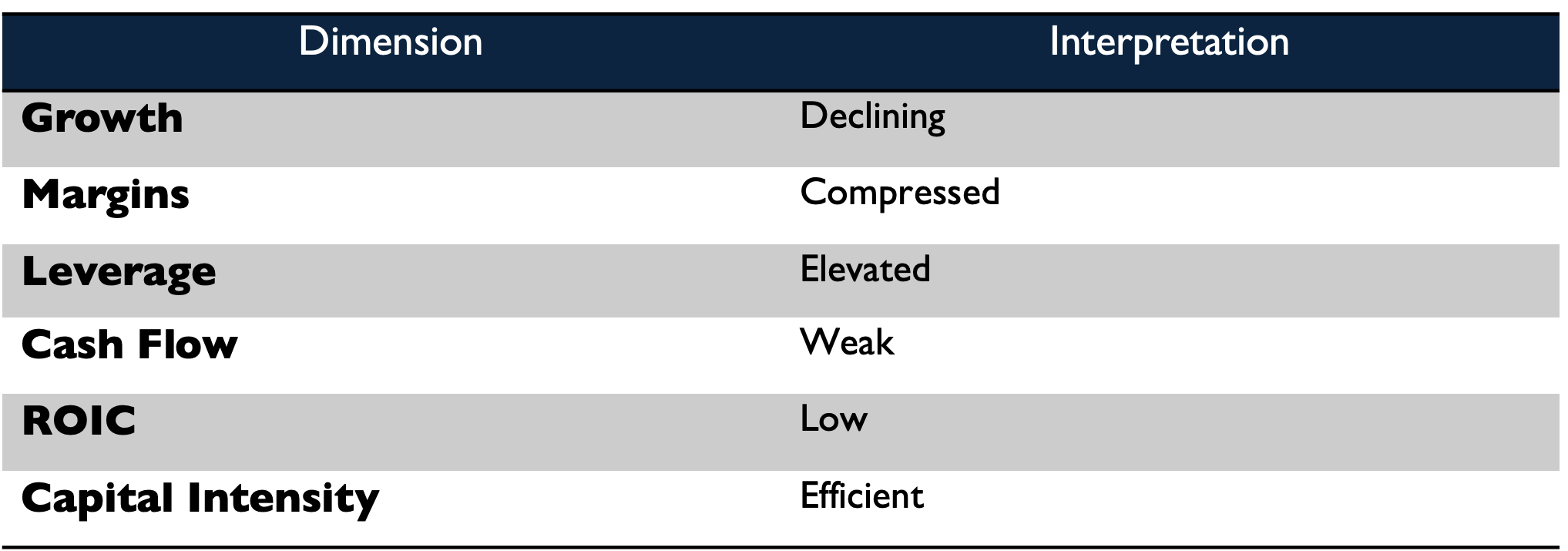
Low capital intensity is the only structural advantage; however, it is insufficient to offset broader weaknesses across growth, margins, and returns.
The economic engine is not aligned with the strategy which raises the next question: Where is the pressure concentrated?
Scene 2.75 — Risk Concentration and Structural Constraints
Financial results rarely deteriorate without underlying structural pressures. Risk disclosures provide a map of where those pressures exist.
A review of Nu Skin’s 10-K reveals that its most significant risks are concentrated in four areas:
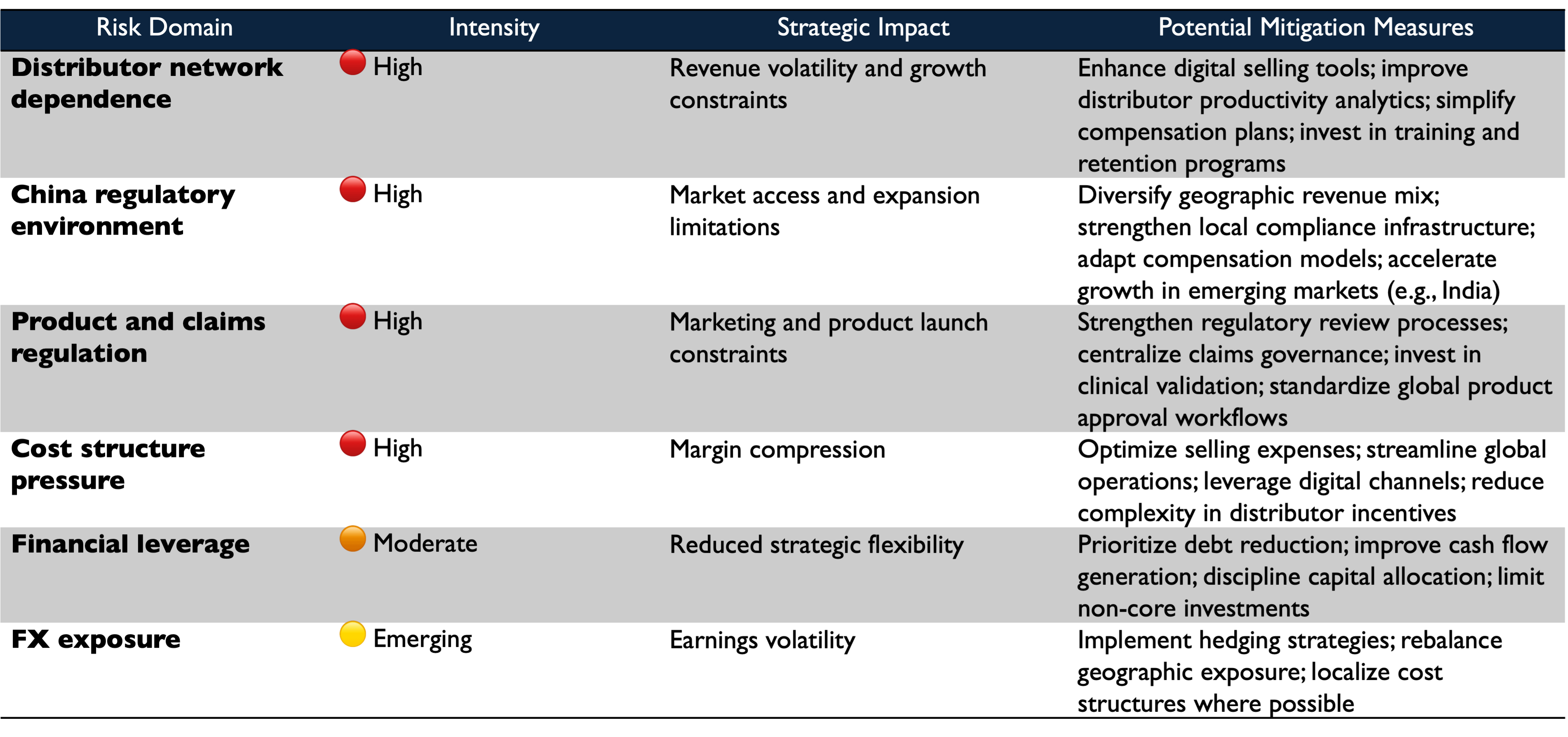
The clustering is telling.
The most critical risks sit directly inside:
The distribution model
The geographic growth engine
The product commercialization process
These are not peripheral risks—they are core to how the business operates.
The constraint is not episodic. It is structural.
Scene Three – Strategy vs. Execution — Identifying the Real Problem

When performance declines, the immediate instinct is to question strategy. However, applying a structured problem-solving lens reveals a different conclusion.
Using Hartley’s Strategic Problem-Solving Framework:
Define the Problem: revenue and profitability are declining despite a strategy aligned with industry trends
Quantify the Impact: negative growth, low margins, and weak ROIC
Identify Root Causes:
Distribution model inefficiencies
Regulatory constraints
Cost structure pressure
Geographic exposure
4. Evaluate Options: digital transformation, operating model integration, cost restructuring
5. Decide: Strengthen execution discipline and global alignment
6. Execute: Align operations with strategy
The conclusion is clear:
The issue is not strategic direction—it is execution and operating model efficiency.
Scene Four – Operating Model Transformation and Leadership Response

Periods of declining performance often reveal where organizations are misaligned—not in strategy, but in execution. When revenue slows, margins compress and returns weaken. Therefore, leadership must determine whether the issue lies in direction or in the ability to deliver results consistently across the enterprise.
At Nu Skin Enterprises, recent leadership decisions suggest the diagnosis has already been made.
Rather than introducing a new strategic direction, the company has expanded its Chief Legal Officer (CLO) role to also serve as Chief Operating Officer (COO), signaling a shift toward tighter operational control, governance, and execution discipline across the enterprise.
This expanded role now integrates:
Global sales channels
Product innovation
Technology platforms
Brand initiatives
Legal and compliance functions
This consolidation is not incidental—it is structural.
The organization is moving from decentralized execution to integrated operational control.
The objective is clear:
Improve coordination
Reduce fragmentation
Strengthen governance
Drive measurable outcomes
This is the playbook of a company moving into a performance improvement phase, where leadership focuses on aligning operations with strategic intent.
Scene Five – A Blue Ocean Reframe — Rethinking the Model
As industries evolve, competitive advantage rarely comes from doing the same things better—it comes from redefining how value is created and delivered.
In the beauty and wellness industry, the traditional direct selling model is being reshaped by:
Social commerce
Influencer-driven marketing
Direct-to-consumer platforms
Data-driven personalization
These shifts are structural, not incremental.
For Nu Skin, this creates a strategic inflection point:
Is growth best achieved by expanding the distributor network or by transforming how customers are engaged and retained?
The implication is glaring:
The future of the business may not lie in expanding the existing model, but in re-architecting it into a digitally enabled, customer-centric platform.
Scene Six – The Brightline Transformation Compass

Transformation efforts can be in good faith but often fail, not because the strategy is unclear, but because the organization is not aligned to execute it.
As companies move from diagnosis to transformation, the challenge becomes one of coordination— ensuring that leadership priorities, operating systems, and organizational behaviors reinforce one another.
The Brightline Transformation Compass provides a structured view:
Direction: Prioritize scalable growth drivers
Leadership: Align accountability under the expanded COO role
Operations: Integrate and standardize global execution
Culture: Reinforce performance discipline and measurable outcomes
For Nu Skin, alignment across these dimensions will determine whether recent leadership changes translate into results.
Without alignment, execution fragments.
With alignment, performance compounds.
Closing Insights – When Alignment Becomes the Strategy

There are moments in a company’s trajectory when the question is no longer what to do—but whether the organization can do it.
Nu Skin appears to be at one of those moments.
The strategy is visible.
The opportunity is real.
But the results suggest something deeper— a misalignment between ambition and execution.
The expansion of the CLO’s role into COO is a leadership adjustment yes, but even more importantly, it is a signal that alignment, not strategy, has become the central challenge.
Alignment of:
Global operations
Distribution channels
Cost structure
Execution discipline
Because in the end, performance is not determined by the clarity of a plan. It is determined by the organization’s ability to execute that plan consistently—across markets, functions, and time.
If Nu Skin restores that alignment, its strategy remains viable.
If not, the gap between intent and results will continue to widen.
Strategy defines the destination.
Execution determines the journey.
Alignment decides whether the company arrives.
About Results Leadership
Averroes Results Leadership examines how leadership decisions, organizational capabilities, operating models, and technology combine to produce—or constrain—enterprise results.
Published by Averroes Business & Technology, LLC, the publication uses evidence-based analysis to connect strategy, execution, and measurable performance across Results Leadership in Business and Results Leadership in Government.
Business analyses incorporate the Business Physics Performance Assessment (BPPA™) to examine the underlying economics that reinforce—or constrain—sustainable performance.
Amir A. Moore, Founder & CEO of Averroes Business & Technology, serves as Publisher, with Lauren Floyd serving as Writer & Editor, helping shape each issue for clarity, rigor, and executive relevance.