


From the Editor
Artificial intelligence is moving rapidly from experimentation into the operating core of the enterprise. For regulated utilities such as Xcel Energy, that transition presents a distinctive leadership challenge: capturing the benefits of AI while protecting the security, reliability, and trust on which critical infrastructure depends.
This issue of Results Leadership examines that challenge through the intersection of AI adoption, cybersecurity, and enterprise governance. As AI capabilities become increasingly autonomous, the leadership question is no longer simply where the technology can create value. It is whether governance, security, accountability, and operating disciplines are advancing at the same pace.
Xcel Energy provides a timely case for examining this balance. The lesson extends well beyond the utility sector: transformative technology creates sustainable value only when innovation and enterprise control mature together.
That is the Results Leadership imperative—advancing innovation without allowing the organization’s capacity to govern it to fall behind.
Introduction — The Utility Transformation Behind the Technology Story
Electric and natural gas utilities occupy an unusual position in the U.S. economy. They are investor-owned enterprises delivering an essential public service under extensive state and federal regulation. Their infrastructure decisions can require billions of dollars, years of construction, and regulatory approval before the investment is fully reflected in customer rates and financial returns.
Xcel Energy entered 2025 in the middle of exactly that kind of transformation. The company was expanding and modernizing transmission and distribution infrastructure, investing in renewable generation and resilience, and preparing for growing electric demand. Its 2025–2029 base capital plan totaled approximately $45 billion, including roughly $15.8 billion for electric distribution, $12.6 billion for transmission, and $5.0 billion for renewables.
The original September 2025 issue emphasized two simultaneous changes: the clean-energy transition and the rise of intelligent, AI-driven systems. That remains an important part of the story. But the broader evidence reveals a more consequential enterprise question. The modern utility must build physical infrastructure, secure regulatory recovery, finance the investment cycle, preserve reliability, manage increasingly complex risks, and govern emerging technologies at the same time.
Can Xcel modernize the grid faster than the financial, regulatory, and operational complexity of that modernization compounds?
That is the Results Leadership question for Xcel Energy. The answer depends less on any single technology than on whether the enterprise operating system can convert a larger, more sophisticated asset base into reliable service, resilience, earnings, and durable returns.
Scene One — Building the Utility of the Future

Xcel serves millions of electric and natural-gas customers across eight states through four regulated utility subsidiaries. Its business model is built around long-lived infrastructure and regulated cost recovery. That makes modernization fundamentally different from transformation in a conventional commercial enterprise: investment is not simply a discretionary growth choice. It is intertwined with reliability obligations, resource planning, environmental requirements, customer affordability, and regulatory approval.
The scale of the investment cycle was already visible. Base capital expenditures increased from approximately $4.9 billion in 2022 to $6.2 billion in 2023 and $7.65 billion in 2024. The 2025 base capital forecast rose to $11.0 billion. Capital spending was therefore expanding far faster than reported revenue, while the physical asset base continued to grow.
This is where the clean-energy story becomes an enterprise-performance story. Renewable generation, transmission expansion, distribution modernization, wildfire mitigation, and other resilience investments all compete for capital, engineering capacity, regulatory attention, supply-chain resources, and organizational focus. Each project may be justified individually; leadership must make the portfolio work as a system.
The objective is not merely to build more infrastructure. The objective is to place the right assets into service at the right time, recover the investment through constructive regulatory outcomes, and produce measurable improvements in reliability, resilience, capacity, and long-term economics.
For a regulated utility, capital deployment is both the engine of growth and the burden that execution must continuously absorb.
Historical evidence: Xcel Energy Forms 10-K for FY2022–FY2024; FY2024 capital forecast.
Scene Two — The Economics of Modernization
Averroes’ Business Physics Performance Assessment (BPPA™) examines how an organization’s financial and operating model translates strategy into enterprise performance. The assessment evaluates six dimensions—Revenue Momentum, Cost Structure, Capital Intensity, Financial Gravity, Cash Conversion, and Energy Efficiency—using company-reported financial data, calculated performance metrics, and defined benchmark ranges. Each dimension is assessed independently and then considered as part of an integrated enterprise system. The purpose is not simply to measure financial performance, but to identify where the underlying economics reinforce—or constrain—the organization’s ability to produce sustainable results.
For Xcel, the BPPA™ requires regulated-utility context. Reported revenue can move with fuel and natural-gas cost recovery and therefore does not carry the same meaning as top-line growth at a conventional operating company. Likewise, negative conventional free cash flow can accompany a major regulated investment cycle rather than signal operating distress. The FY2024 assessment therefore retains the same six-dimension methodology used across Results Leadership while interpreting capital intensity, financing burden, regulatory recovery, cash funding requirements, and return efficiency within Xcel’s business model.
BPPA™ Results Leadership Assessment
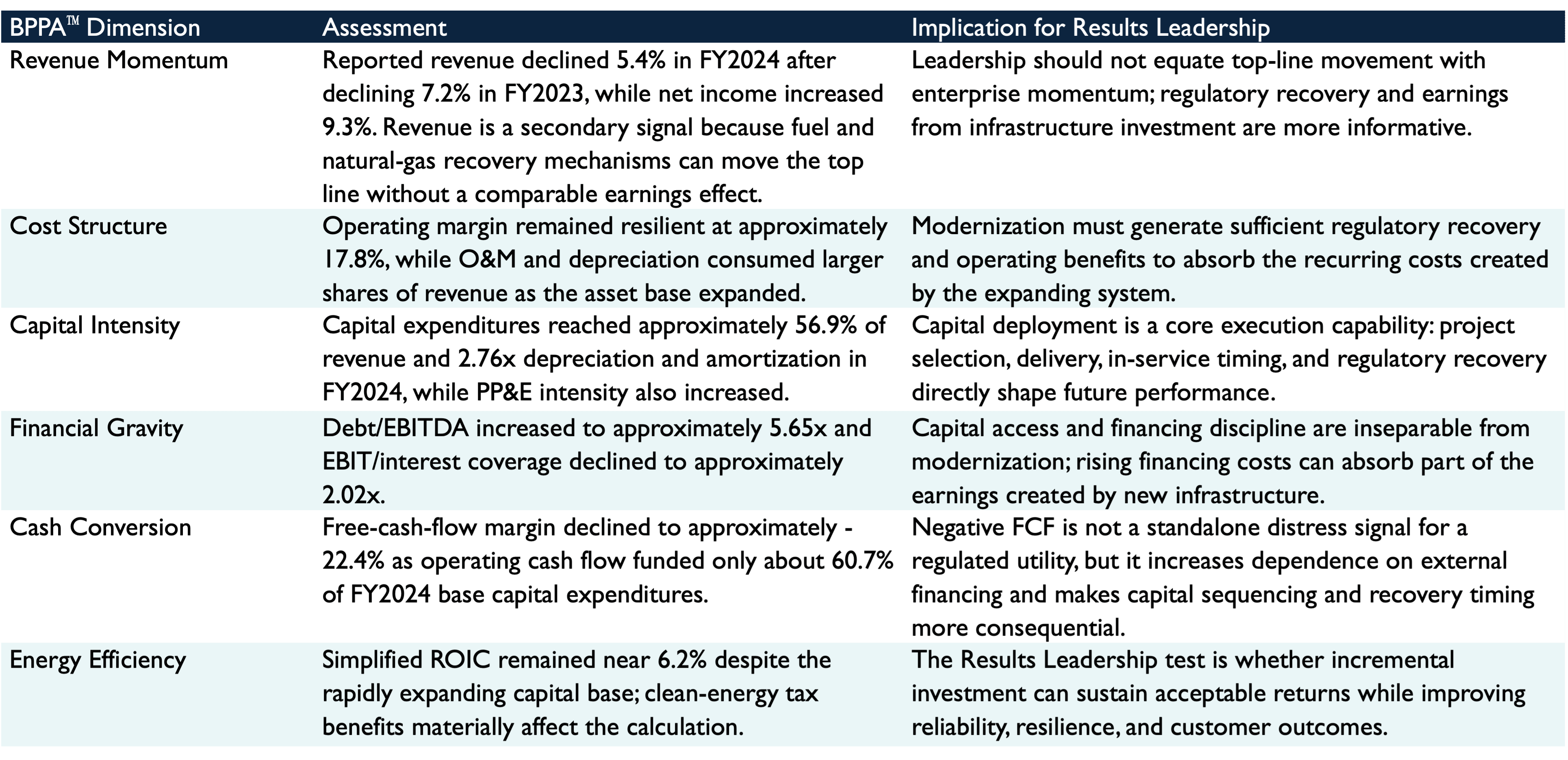
Viewed together, the BPPA™ dimensions show a regulated utility operating through an accelerating investment cycle. Operating margins and simplified return efficiency remained comparatively resilient, but capital intensity, debt requirements, interest burden, and the gap between internally generated cash and capital spending all increased. The central Results Leadership issue is therefore not whether Xcel is investing enough; it is whether capital deployment, regulatory recovery, financing capacity, operational resilience, and technology governance remain aligned closely enough for an increasingly complex modernization program to translate into durable enterprise performance.
The first half of 2025 reinforced that interpretation. Q2 diluted EPS increased to $0.75 from $0.54 a year earlier as greater recovery of infrastructure investments supported earnings, while higher operating and maintenance expense, depreciation, and interest costs demonstrated the recurring burden created by the expanding system. The investments creating future earnings were simultaneously creating the costs those earnings needed to overcome.
BPPA™ calculations use reported Xcel financial data. Simplified ratios and benchmark scores are retrospective Averroes analytical measures, not company-reported KPIs or external industry ratings.
Scene Three — When Investment Becomes Enterprise Complexity
Capital does not become performance automatically. As the system expands, the organization must manage a broader set of interdependent risks: grid reliability, wildfire exposure, severe weather, supply-chain constraints, workforce capacity, nuclear compliance, cybersecurity, regulatory proceedings, commodity markets, and financing conditions.
That is why resilience belongs inside the investment thesis rather than beside it. A transmission line, distribution upgrade, renewable project, or wildfire-mitigation program creates value only when the enterprise can plan it, finance it, build it, operate it safely, and recover its cost while maintaining customer trust and system reliability.
Technology increases both capability and complexity. Xcel’s public disclosures identified cybersecurity and emerging artificial-intelligence risks, while industry work involving Xcel security leadership reflected growing attention to agentic AI. The evidence supports treating AI governance as an emerging critical-infrastructure issue—but not as proof that autonomous AI had already become broadly embedded across grid operations.
The mature leadership question is therefore not simply whether Xcel should adopt AI. It is where advanced analytics and increasingly autonomous systems can improve monitoring, resilience, cybersecurity, or decision-making—and what governance must accompany those uses when errors can affect essential services.
This also changes how we interpret risk. The original issue proposed specific governance structures and technology controls. Those were Averroes prescriptions, not evidence of Xcel’s actual operating model. The reconstructed analysis instead focuses on the documented enterprise requirement: technological sophistication must advance with accountability, traceability, cybersecurity, operational controls, and regulatory discipline.
AI matters most when it strengthens the utility system—not when it merely makes the utility more technologically sophisticated.
Source boundary: Xcel FY2024 Form 10-K and public material available before the September 2025 archive cutoff. Unsupported claims about specific AI deployments have been removed.
Scene Four — Converting Capital into Durable Performance

The final test is synchronization. Xcel’s capital plan cannot be evaluated independently from the regulatory, financial, operational, and governance systems that support it. A larger asset base can create future earnings, but it also creates depreciation, maintenance requirements, financing costs, operational complexity, and exposure to execution delays.
The first half of 2025 illustrates the balance. Xcel generated approximately $2.1 billion of operating cash while investing activities used about $4.4 billion. Financing activities generated approximately $3.6 billion. The company was therefore simultaneously operating the current system, funding the next system, and raising the capital required to bridge the two.
Regulation is central to that conversion. For Xcel, regulatory execution is not adjacent to operating execution; it is one of the mechanisms through which infrastructure execution becomes financial performance. Projects must move from planning and construction into service, and the associated investment must be recognized through appropriate recovery mechanisms. The Q2 earnings pattern—higher infrastructure recovery offset by higher depreciation, O&M, and interest—shows the system in motion.
This is where Results Leadership moves beyond project completion. The question is not whether Xcel can execute a transmission project, a renewable program, a resilience initiative, or an AI-security effort independently. It is whether the enterprise can keep those investments aligned with capital access, regulatory outcomes, workforce capacity, risk controls, and customer obligations over a multi-year transformation.
Final Insights — Modernization Is an Enterprise Operating System
Xcel Energy’s transformation illustrates a broader leadership principle: the larger the investment agenda becomes, the more performance depends on the system surrounding the investment.
The company entered 2025 with an expanding infrastructure program and a $45 billion five-year base capital plan. The BPPA™ makes the consequences of that scale visible. Capital intensity was rising, debt and interest costs were increasing, and internally generated cash was funding a smaller share of the capital program. Yet operating margin and simplified return efficiency remained comparatively resilient, demonstrating that the modernization cycle was producing financial capacity even as it increased the burden on that capacity.
That is why the central issue is not whether Xcel is spending too much or too little. The more consequential question is whether investment, regulatory recovery, financing capacity, operating performance, resilience, and governance remain synchronized as the system grows.
The same principle applies to technology. AI and advanced digital capabilities can improve monitoring, cybersecurity, forecasting, and decision support. But in critical infrastructure, technological capability cannot outrun governance. Adoption must remain connected to reliability, accountability, data protection, operational controls, and the regulatory environment in which the utility operates.
The leadership challenge is therefore one of conversion. Capital must become infrastructure. Infrastructure must become reliable service. Regulatory recovery must convert infrastructure into earnings and returns. Financing must remain available to sustain the next investment cycle. And technology must increase capability without introducing unmanaged operational risk.
Results Leadership is achieved when investment does more than expand the enterprise—it increases the enterprise’s capacity to perform.
For Xcel Energy, that is the standard by which modernization should ultimately be judged.
About Results Leadership
Averroes Results Leadership examines how leadership decisions, organizational capabilities, operating models, and technology combine to produce—or constrain—enterprise results.
Published by Averroes Business & Technology, LLC, the publication uses evidence-based analysis to connect strategy, execution, and measurable performance across Results Leadership in Business and Results Leadership in Government.
Business analyses incorporate the Business Physics Performance Assessment (BPPA™) to examine the underlying economics that reinforce—or constrain—sustainable performance.
Amir A. Moore, Founder & CEO of Averroes Business & Technology, serves as Publisher, with Lauren Floyd serving as Writer & Editor, helping shape each issue for clarity, rigor, and executive relevance.